Sunday, April 16, 2006

Memorial Day documentary pitch

You are reading http://rriverstoneradio.blogspot.com/

Wounded Warrior: Native American Veterans Return to “The World”
By Rogi Riverstone
rriverstone at rriverstone.com

Like many soldiers returning from their war experience, Native American Veterans face the effects of Post Traumatic Stress Disorder (PTSD). Because many of them come from rural and reservation settings, Native American veterans find few support services. This makes them susceptible to what is known as “Sanctuary trauma,” defined as the worsening of psychological symptoms by a support system that fails a traumatized individual. However, there are a few researchers, healing specialists, and social servants who are working to improve reintegration for Native American Veterans by utilizing traditional, Native spirituality, ceremony and ritual into recovery and healing. Traditional reintegration ceremonies for Native warriors include trance and self-hypnosis, to recover subconscious trauma. These practitioners believe these traditional methods could also be beneficial to non-Native peoples who have suffered the effects of trauma.

I plan to interview Native healers, themselves Veterans, who work with Native Veterans. These include Albert Laughter (Navajo), medicine man and Michael Villanueva (Pueblo), Ph.D., CPT (USAR). Both integrate traditional methods with so-called, “Western” medicine. I hope to interview Steve Silver, Ph.D. from the National Center for PTSD (NCPTSD) Clinic at the Center for Veterans Affairs, who is involved in researching traditional Native healing. I will also interview local Native American Veterans about their experiences. I will incorporate healing songs, from a local, Native drumming group and ambient sounds from on-location field recordings to add color to the piece. Through interviews with Native Vets, service providers, family members and community members, we will also examine Native concepts of the role of the warrior, instruction in warfare, traditional values of battle ritual, and social reintegration ceremonies. These will be contrasted with Natives’ experiences with US military policies and procedures, which, some in this field say, exacerbate psychological damage.


I plan, as much as possible, to allow Native Veterans to tell their own stories, in their own words, with brief comments from Dr. Silver. I may open the piece with a brief passage from the novel, Ceremony, by Leslie Marmon Silko: about a Laguna service member returning from combat to his reservation and facing the traumas of his experiences.

This story is timely, as young men and women, Native and non-Native, return from wars in the Middle East and face the trauma of inadequate services at home. If their treatment incorporated traditional, Native techniques and practices, some say, the impact of their traumas could be used for healing, for themselves and their communities.


Friday, April 14, 2006

Native American Vets radio documentary


You are reading http://rriverstoneradio.blogspot.com/

Seeking Native American Veterans
Plus Families, Friends & supportive others
Willing to be interviewed
For a radio documentary
To be aired Memorial Day Monday, May 29, 2006

We want to hear your experiences, challenges, frustrations, needs. This is a half-hour piece, to be aired nationally, on affiliated, community radio stations. Your words will be heard with the respect, dignity and compassion you deserve. What do you want to say?

Also seeking local, Native American musicians, poets, spoken word artists with compositions about Native Warriors, Veterans, Peacekeepers, etc.

You will get credits and recognition for this national broadcast.

Contact: Rogi Riverstone
PO Box 4609 Albuquerque, NM 87196

Monday, April 10, 2006

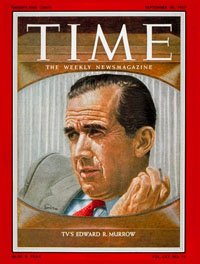
Murrow Quotes


For Tom Trowbridge


“Just once in a while let us exalt the importance of ideas and information.”
“We cannot make good news out of bad practice.”
“We're going to go with this story. Because the terror is right here in this room.”
“Difficulty is the excuse history never accepts.”
“Our major obligation is not to mistake slogans for solutions.”
“We cannot defend freedom abroad by deserting it at home.”
“No one can terrorize a whole nation, unless we are all his accomplices.”
“We are in the same tent as the clowns and the freaks-that's show business.”
“Anyone who isn't confused really doesn't understand the situation.”
“If we were to do the Second Coming of Christ in color for a full hour, there would be a considerable number of stations which would decline to carry it on the grounds that a Western or a quiz show would be more profitable.”
"We must not confuse dissent with disloyalty.”


Tom,
I hold you in the highest regard.

Rogi A. Riverstone

Thursday, September 01, 2005

Katrina

You are reading http://rriverstoneradio.blogspot.com/

Is my credit card information secure?My donation was denied. Why?Can I cancel a donation?View All FAQsAmerican Red Cross Emergency Vehicles respond to disasters nationwide.Did you know... The American Red Cross provides assistance to people in need... free of charge... every single day!Donate by Phone Donate by Mail Donate Spare Change Donate In-Kind Products Donate Airline Miles Donate Stock Latest NewsPrivacy Policy Dear Rogi,Thank you for your generous gift to the American Red Cross 2005 Hurricane Relief Fund. This fund makes it possible for the Red Cross to help nationwide Hurricane disaster victims of 2005 with critical needs such as shelter, food, clothing, counseling and other assistance. It's because of the 2005 Hurricane Relief Fund that our response can be immediate regardless of its location or the community’s ability to financially support our efforts. Your generous support means the most to the families who rely on Red Cross to help them through some of the most difficult times of their lives. Please continue to visit us at http://www.redcross.org/ to see how we’re using your 2005 Hurricane Relief Fund donation to make a difference, and for the most current disaster updates and stories about the people being helped.Together, we can save a life.American Red Cross*************************************************To verify that your company participates in a matching gift program, please contact your human resource representative.Please print or save this message for your personal records.Donation InformationDonation Form:Hurricane 2005 Relief and other Related EventsThis organization's tax ID is:53-0196605This letter serves as the tax receipt for your gift. The American Red Cross is a tax-exempt, nonprofit organization as described in section 501(c) (3) of the IRS Code for 1984, as amended. Our tax identification number is 53-0196605. Adequate records will be maintained and made available to the IRS upon request. In accordance with IRS regulations, no goods or services were provided to the donor by the American Red Cross as part of this contribution.Your gift may be recognized in future Red Cross publications. If you prefer your gift to remain anonymous, or have questions about your gift’s designation, or would like to learn more about the services that the Red Cross is committed to providing, please call 1-800-797-8022.The American Red Cross is not a government agency and all Red Cross disaster assistance is free thanks to the generosity of people like you. The value of your donation is increased by the fact that the ratio of volunteer Red Cross workers to paid staff is almost 36 to one.Contributions to the American Red Cross, a tax-exempt organization under Section 501(c)(3) of the Internal Revenue Code, are deductible for computing income and estate taxes.© Copyright The American Red Cross. All Rights Reserved.

Thursday, April 07, 2005

auction

You are reading http://rriverstoneradio.blogspot.com/

One can find info on this "auction" at http://kunm.org

I was horrified and wrote this:

Seems Goodman has also agreed to "Preferred" seating, with reservations, to her lecture for KUNM volunteers. Well, a dinner conversation is different than a lecture. We don't get to interact; we just get to listen, closer than the rest of the thundering herd.

It's not ok to exclude the majority.

E-mail message

(Gather�ideas�from�KUNM�volunteers)
From: (Rogi�Riverstone)
Date: Tue, Apr 5, 2005, 4:26am
To: KUNMIDEAS-L
Subject: Re: [KUNMIDEAS-L] KUNM Benefit Online Auction with Amy Goodman

"The minimum bid for the KUNM auction is $125.00. If you make a generous contribution of $1,000 we will automatically reserve a seat at the table for you, with no other bid required."

These "twenty, lucky winners" aren't lucky, at all; they're privileged. Period.

Volunteers come to KUNM and toil tirelessly to keep COMMUNITY radio on the air. Those contributions are, in my opinion, taken for granted by staff, whose salaries come, in large part, from the hard work of volunteers.

Not ONE seat at this table is reserved for volunteers. MANY of us are low income, and could NEVER afford a seat at that table.

"Whatsoever you do to the least of these, that you do also unto me." -- Jesus

Thank you, one, more time, for the respect and dignity we volunteers deserve as the backbone of the station: a station which, more and more, reflects the privileged and not the COMMUNITY from which it comes.

That Amy Goodman agreed to this speaks volumes as well.

This is community radio; it is not a country club. Nor is it a college fraternity.

Thank you,
Rogi Riverstone
http://rriverstone.com

Exclusive

You are reading http://rriverstoneradio.blogspot.com/

This is an email to the KUNM ideas list, re: a "benefit" for the station.


E-mail message

(Gather�ideas�from�KUNM�volunteers)
From: (Rogi�Riverstone)
Date: Thu, Apr 7, 2005, 8:45am
To: KUNMIDEAS-L
Subject: Re: [KUNMIDEAS-L] KUNM Benefit Online Auction with Amy Goodman

Words like "preferred" (as in seating) and "exclusive" (as in undisclosed location of events for the wealthy, to keep us riff raff out) are, in my opinion, the antithesis of community. They divide. They don't unite.

Statistically, I've heard and read, it is the people more likely to use the services of nonprofits and charities who donate the most to them. Therefore, lower working class people donate the most.

My experience in community fund raising teaches me that it's a lot easier to get a thousand people to donate twenty dollars each than to get twenty to donate a thousand each.

And this is for a radio station; we have the ability to promote events very handily to most of the state.

We have great talent in Albuquerque: artists, environmentalists, musicians, chefs, lecturers, poets..... Many of them would donate their time and knowledge to fundraisers. Nature walks on water conservation and native plants. Poetry slams. Crafts festivals. Dinner-for-two raffles. Open mic picnics. KUNM Aid concerts. Bed and breakfast weekends......

It would be a fabulous way for listeners to meet each other, to build a sense of community. We could get to know each other. I saw many people who were very excited to hear from each other at the media conference at TVI. A lot of us didn't know others felt as we did. It was very healing.

I worry about the influence the wealthy can have over programming decisions at KUNM. Who lives in Santa Fe? Shirley McLaine? Who, in "Out On A Limb," (the LAST time I'll ever read a book by her), said she no longer felt a sense of duty to social justice, because, in her warped interpretation of "karma," has decided people CHOOSE to live in suffering, to work out some hidden, cosmic agenda!

Or maybe it'll be Ali McGraw, who, on a KNME special about celebrities and trees, whined that she must stoop under the branches of a pinon that grows in her yard, because she refuses to allow her (working class) gardener to trim it. No mention was made of how much fun it must be for the gardner to conk his/her head on the branch and get stabbed in the eye, trying to rake under the tree.

Maybe Santa Fe only wants to hear new age happy talk? Maybe they only want white, talking heads? Maybe they want puff about their investments?

Scott Company underwrites programming on PBS. They produce Round Up. Monsanto pushes GMOs that are Round Up resistant in the 3rd world. Their subsidiary, Abbot Pharmacies, produces AIDS drugs. The deal is: if 3d world govts. refuse to allow GMO crops, Abbot won't provide low-cost AIDS meds. Scary.

And ADM underwrites PBS news: supermarket to the world. Scary.

The agenda of the wealthy worries me. Remember in Paper Moon. Dad says he won't do something because, "I have scruples. You know what scruples are?" Daughter replies, "No, I don't know what scruples are. But if you got 'em, you sure as hell stole 'em from someone else!" Privilege comes, almost always, at the expense of others.

So, promoting an event in which most people can't participate and aren't even allowed to know its venue sends a message to KUNM listeners which I find extremely problematic.

Amy Goodman, who sneered at the Bush campaign's multi-thousand-dollar a plate dinners, in which GW smiled to the wealthy and said, "YOU are my constituents," scoffed at Bush rallies, in which the Department of Homeland inSecurity BARRED any but the faithful from attending, is participating in what, to me, is just as exclusive and just as dismissive of the struggles of low income people. Having all the verses to "Brother, Can You Spare A Dime" memorized is not radicalism.

Exploiting the urgent needs of the poor to self-promote (which is what it's starting to look to me like she has done to sell books) is evil, whether republicans do it or communists do it.

I'm hurt. I'm offended. If I can't trust community radio to represent my needs, whom shall I trust? Fundamentalists? Fascists? Corporations?

Thank you,
Rogi Riverstone
http://rriverstone.com

Friday, February 18, 2005

ClearChannel: Liberal?

You are reading http://rriverstoneradio.blogspot.com/

Clear Channel adopts liberal programming on growing number of stations
Date: Friday, February 18 @ 10:11:00 EST
Topic: Media
From The Associated Press

DETROIT -- The day before President Bush's inauguration, listeners tuning in to the Detroit sports station WXDX-AM were suddenly greeted by the sound of braying donkeys. By the time Bush was taking the oath of office, the radio station had new call letters and a full schedule of liberal talk shows.
WXDX-AM -- now known as WDTW-AM -- is one of 22 stations owned by Clear Channel Communications Inc. that have switched to a liberal talk format in the last year. This month, KTLK-AM in Los Angeles became the latest Clear Channel station to adopt the format.

Those who track broadcasting trends say there's money to be made in liberal talk radio. Todd Webster, a consultant for Washington-based liberal talk show producer Democracy Radio, said Clear Channel is expected to introduce the left-leaning format on 20 more stations by the end of the year.

"There is a tremendous appetite out there for progressive talk," he said.

Webster said that even as recently a year ago, no one thought Texas-based Clear Channel, a media conglomerate that owns 1,200 stations -- including Twin Falls radio stations KEZJ-FM, KLIX-AM and KLIX-FM -- would ever become partners with upstart liberal talkers.
"There has been a tectonic shift in the industry from all of the big brains and the head honchos saying, 'Nobody wants to listen to a bunch of whiny liberals on the radio,"' Webster said.

The partnership might seem surprising because of Texas-based Clear Channel's conservative reputation. Clear Channel CEO Lowry Mays and his wife gave $65,000 to the Republican National Committee in the last election cycle, and two-thirds of the company's federal donations went to Republicans, according to the Center for Responsive Politics.

And last summer, a Berkeley, Calif.-based group sued Clear Channel, which also owns an outdoor advertising business, after it refused to run an anti-war billboard in Times Square during the Republican National Convention.

The company also isn't seen as socially progressive. In December, Clear Channel stations in Tampa, Jacksonville, St.
Louis and Detroit awarded breast enhancement surgeries to 13 women as part of the "Breast Christmas Ever" contest; at the time, the company said it had no oversight of the contests and didn't sponsor them. Clear Channel also pulled talk show host Howard Stern off the air because of concerns over mounting indecency fines.
The company says politics aren't involved in its decision to put liberal talk shows on the air.

"I'm trying to identify needs in our various communities, whether it's German industrial music or punk rock or progressive talk," said Gabe Hobbs, vice president of news and talk programming for Clear Channel. "That happens to be good business."

Hobbs said Clear Channel began programming offerings from Air America Radio, which produces comedian Al Franken's three-hour talk show, and Democracy Radio, which produces a popular show by liberal talker Ed Schultz, because listeners were demanding an alternative to conservative talkers like Rush Limbaugh during the 2004 election.

"The election dramatically raised everyone's interest in hearing political talk," Hobbs said. "I think polarization is one of the facets of any talk radio format, regardless of orientation."

Hobbs said liberal radio is actually a return to the days before Limbaugh, when talk radio was dominated by left-leaning hosts like Alan Colmes, who is now seen on Fox News Channel's "Hannity and Colmes."

Local station managers have the final say over the switch in programming. At WDTW, General Manager Dave Pugh was eager to give Detroiters a format they couldn't find anywhere else.

"We are a blue state and a blue region and it just made sense," Pugh said.

From Associated Press:
http://www.magicvalley.com/news/business/index.asp?StoryID=7501

This article comes from The Smirking Chimp
http://www.SmirkingChimp.com

The URL for this story is:
http://www.SmirkingChimp.com/article.php?sid=19969

Tuesday, February 01, 2005

Queer & Homeless

You are reading http://rriverstoneradio.blogspot.com/

PRESS RELEASE The 8th Annual Homelessness Marathon
FOR IMMEDIATE RELEASE
MEDIA CONTACT:
Rogi Riverstone
Albuquerque: 505-842-8175
Toll Free: 1-877-718-0691
(rriverstone@yahoo.com)

8th ANNUAL HOMELESSNESS MARATHON Broadcasting in Albuquerque

Local producers will carry a live, hour discussion, to be aired at 10pm local time, on the impact of homelessness on Gay, Lesbian, Transexual, Transgendered, Pansexual and Bisexual people in Albuquerque. Stay tuned to KUNMfm 89.9 and http://kunm.org for further details.

The 8th Annual Homelessness Marathon is a nationally-produced show. Participating Pacifica, NPR and independent, community and public radio stations will both broadcast and air it. The Marathon will be broadcast from 9pm, EST on Monday, February 14th to 11am, EST on Tuesday, February 14, 2005. The broadcast will be carried on KUNMfm 89.9.

The Homelessness Marathon has been called, "the most significant media event focusing on homelessness and poverty" by Donald Whitehead, director of the National Coalition for the Homeless. And it is unlike any other broadcast in the world.
The Marathon is almost entirely live, covers taboo territory and features the voices of people who are rarely heard on the air. Perhaps for this reason it has grown rapidly. The first Marathon, in 1998, was on one tiny station in central New York. The 7th Marathon, in 2004, was on 80 stations coast-to-coast, with another 30 stations across Canada carrying a parallel Canadian Homelessness Marathon.

As always, the 8th Marathon's broadcast booth will be set up outside, to dramatize the plight of people with nowhere to go in the cold, and calls will be taken from around the country. But there will be no on-air solicitations. The Marathon is a consciousness raising, not a fundraising broadcast.
The 8th Marathon will be distributed via the NPR and Pacifica satellites and will be streamed on the web. More information, including broadcast schedules and audio clips from past broadcasts may be found at the Marathon's web site: http://kunm.org and http://www.homelessnessmarathon.org.

Tuesday, January 18, 2005

Women's International News Gathering

You are reading http://rriverstoneradio.blogspot.com/

Dear WINGS contributing producers:

I am opening a new email for WINGS producers to write to me. It is wingsproducers@yahoo.com. Using this email will keep your messages from bouncing when the wings@wings.org email box is full, and will make it easier for me to keep track of our correspondence.

WINGS is also going to try something different this year, which is a discussion list for WINGS producers.
Soon you will get an invitation from yahoo asking you to join the wingsproducers@yahoogroups.com listserve. � Please respond to it if you are willing to receive email from this list.

The 40 producers I am inviting work in 16 countries. Almost all of you have had a piece appear in WINGS in the past two years. A few have pieces that are pending or have proposed ideas that I feel confident you can complete.

The reason I am creating this listserve, is that I feel it is not good for just me to be the only person at WINGS who is in touch with all of you. Using this list, you can help set priorities, share ideas and leads, and pressure me to do my job of coordinating better. My hope is that we will develop a sense of community around being active in WINGS.

Only members will be able to send messages to this list, or receive messages from it. If you feel there are too many messages, I will change it to be "moderated," so that messages for the whole list only come through me.

If you have a yahoo.com email account, you will also be able to see things posted to the web for this group. There should be enough room for pictures and audio. Right now, we have 250 megs of space, which is equivalent to about 10 half-hours of mp3 sound. � It is possible to purchase more space.

If you do not have a yahoo.com email account, you can receive emails but not see what is posted on the web. I believe you can register to get a free yahoo email account, at www.yahoo.com. Let me know if you change your email.

You can write to just me at wingsproducers@yahoo.com. The email for the whole list will be wingsproducers@yahoogroups.com.

Hoping to see you together online.

Frieda
Frieda Werden, Producer,
WINGS: Women's International News Gathering Service,
Box 95090, Kingsgate
Vancouver BC V5T 4T8
Canada

Tuesday, January 11, 2005

where's da broadcast?

You are reading http://rriverstoneradio.blogspot.com/

KNME, our local PBS station, shares our transmission tower. Well, at three days' notice, they've informed us they'll be knocking us off air from midnight to 5am all week.

Our volunteer coordinator is madly riding her bike all over town, locating late night broadcasters who don't have phone and email, informing them they don't need to come in.

At 6:38 this morning, our poor station STILL didn't have a signal!

Our Chief Engineer posted the following in our email list:

Dear Boss,

I like 1.6 million other New Mexicans will be late to work today due to the failure of radio station KUNM to wake me up. �Please note that KUNM was off the air until
6:33 AM and therefore I am running an hour and a half late.

Please don't blame KUNM as they have no control over the situation and are at the mercy of KNME-TV who held the FM station at bay until after 6:30.

Should you have any questions concerning my lateness, please contact Ted Garcia or James Gale, KNME-TV, (505) 277-2121.

I'd like to avoid being tardy again, but you should expect this from me as KUNM will be off the air again over the next three nights.

Sincerely,

Joe Employee

Monday, January 10, 2005

Homelessness Marathon

You are reading http://rriverstoneradio.blogspot.com/


Homeless?

Gay, Lesbian, Transgender, Transexual, Bisexual, Pansexual?

We want to hear from you!

Join us for a live discussion.

February 14, 2005


(hour still to be determined)


KUNMfm Albuquerque (http://kunm.org) will host a one-hour broadcast during the Homelessness Marathon. Our local focus will be about the issues facing the Queer community who are homeless.

Participants have the options of remaining anonymous. We can even digitally alter your voice, so you can't be recognized.

We want to hear your experiences, not cause further victimization. Your voice matters. Your experience is important. This is an opportunity to tell a national audience what life is like as a homeless person who is maginalized as a result of your sexuality, gender and orientation.


(505) 842-8175 Albuquerque or 1-877-718-0691

rriverstone@yahoo.com

The URL for this flier is

http://rriverstone.com/homelessmarathon/flier.html

Please feel free to print, distribute and post this flier anywhere!


Friday, October 22, 2004

CURSE on radio

You are reading http://rriverstoneradio.blogspot.com/

Food for thought:

Several speakers described the steady process of de-democratization that has been going on there, the transference of decision-making from volunteers to one autocratic paid staff person, and the gag rules and dismissals placed on volunteers who voiced protest. A speaker from KUNM, New Mexico, described the successful listener fight at her station several years back, in a surprisingly similar situation. This kind of thing has been going on at stations all over the country, where those who want to attract ratings and appeal to a "safe," homogenized audience are using arbitrary power to take choice out of the hands of the community. In some of those situations, management has won, but in others, listeners have been successful in taking back their stations.

Both DJ Riz, who spoke at the forum, and the speaker from New Mexico, discussed the necessity not only to take back community radio but also to expand it to become more truly responsive to the community, including a diversity of cultural groups: Latinos, Asians, women, queers, and disenfranchised white males. Speakers were heavily applauded by the audience for such statements as "you are not the respectable Arbitron listeners," and "you don't want familiarity, you want to be offended and challenged by what you listen to." When management says that they want to tone down the station to make it more "respectable," they claim that there is no audience for what the "maverick" DJs are playing. The CURSE meeting showed that there is an audience for so-called "harsh and abrasive" music (and harsh and abrasive opinions), and it is us.

http://www.bloofga.org/il/il_v1/output/indie-list-9.html

Thursday, September 30, 2004

The marshalls and the microstation

You are reading http://rriverstoneradio.blogspot.com/

Posted on Thu, Sep. 30, 2004

Marshals shut down Santa Cruz radio station
CROWD BACKS TINY HOST TO LOCAL PROGRAMS
By David L. Beck
Mercury News

Guns drawn, agents of the U.S. Marshals Service served a warrant on a tiny Santa Cruz pirate radio station early Wednesday, rousting and frisking the pajama-clad residents of the co-op house from which the station had been broadcasting. No one was arrested.

``This is not a criminal action against people,�� said Supervising Deputy Cheryl Koel.

The target was Free Radio Santa Cruz, an FM micro-station boasting 35 to 40 watts of power and offering round-the-clock music, activism and other local programming, in addition to such national programming as Radio Pacifica's ``Democracy Now��-- all in defiance of federal licensing laws.

The blue-jacketed marshals, along with agents of the Federal Communications Commission, dismantled the station's equipment and carried it to a waiting pickup with a camper shell as a crowd of perhaps 60 people yelled ``Shame! Shame!�� and ``Go home!��

Residents, programmers, friends of alternative radio and enemies of corporate media were joined by two city council members, one council candidate and two congressional candidates. They milled around on the sidewalk and in the street, careful to avoid traffic.

Culinary consultant Joseph Schultz, founder of the legendary but now defunct India Joze, brought vegetable soup.

But despite Koel's assurances, residents of the house on Laurel Street did feel ``acted-against.��

``They got me out of bed,�� said Erin Calentine, 21. ``They were yelling, `Federal marshals! We have a warrant! Come down! We�re here for the radio,� �� she said.

After being frisked, the residents were kept outside for about half an hour while the marshals ``secured the location,�� said Calentine, quoting the marshals.

Mayor Scott Kennedy and Councilman Mark Primack condemned the raid, while candidate Tony Madrigal, a union organizer by profession, led a chant of ``S�, se puede�� -- the Cesar Chavez motto that means ``Yes, we can.�� The student co-op house is named for Chavez.

Kennedy said the city would be willing to lend assistance, perhaps by filing a friend-of-the-court brief. The fact that the station frequently airs criticism of city government ``makes it important�� that the city support it, Kennedy told the Santa Cruz Sentinel last year.

The warrant bore no names, listing as ``defendant�� ``any and all radio station equipment . . . used in connection with the transmissions.�� It gives the station operators 20 days to respond in court.

``I don�t want the reason we�re doing this to get lost in the hubbub about the raid,�� said George Cadmon, who hosts a show called ``Peace Talks.�� ``This is civil disobedience, anti-corporate action, First Amendment protest. We feel very strongly that local voices aren�t getting out there.��

Evelyn Hall hosts a program called ``Eye of the Storm,�� which she describes as ``spiritual activism.�� Her daughter and a friend, both 11, have their own show, too, called ``For Your Information.�� And so does her mother, Michelle Hall, 74.

``Could it be,�� she wondered, ``they are really kind of worried?�� Hall asked, reflecting the paranoia and anger circulating in the crowd.

The station's technical director, who as Uncle Dennis plays 1960s and '70s rock, psychedelic music and blues, said the FCC has had its eye on the station for years. Uncle Dennis said the station has moved several times during its nine-plus years of life on the fringes of broadcasting.

The FCC spokeswoman declined comment on the case except to say that it was an open investigation. A spokesman for the U.S. Attorney's office in San Francisco suggested a reporter consult the station's Web site, www.freakradio.org, where it charges that the FCC ``has proved itself to be controlled by monied interests.��

Cadmon estimated the value of the equipment seized at $5,000, including the antenna agents removed from the roof.

Contact David L. Beck at dbeck@mercurynews.com or at (831) 423-0960.


http://www.mercurynews.com/mld/mercurynews/news/9797653.htm?1c

Friday, September 24, 2004

Living on Earth

You are reading http://rriverstoneradio.blogspot.com/

LivingOnEarth.org

McCain's Climate Change Campaign

The debate over climate change has largely been a polarized one on Capitol Hill. Many Democrats and Republicans stand on opposite sides of the fence when it comes to setting standards for controlling emissions, and the Bush administration has been slow to respond to signs of global warming. Senator John McCain is one of a few Republicans who are actively pushing for action on climate change. He co-authored a measure with Democratic Senator Joe Lieberman that would have been the first federal mandate for limiting greenhouse gases like carbon dioxide.
It failed to pass the Senate, but the Senator McCain says that, much like his crusade for campaign finance reform, he won't give up on global warming. Living on Earth talks with John McCain about his climate change crusade.

Hurricanes and Global Warming

In the wake of Frances and Ivan, Living on Earth takes a look at the connection between these extreme weather events and climate change.

Burrowing Owls

Researchers find animal dung is the bait of choice for ground-dwelling owls in the desert southwest.

Living on Earth Mailbox

Listeners weigh in on recent stories.

Eco-Pilot

We take a ride with pilot Sandy Lanham, who spends hundreds of hours a year tracking Mexico's endangered wildlife in her 48-year-old Cessna.

Saturday, September 18, 2004

Bill Moyers: Journalism Under Fire

You are reading http://rriverstoneradio.blogspot.com/


Bill Moyers: 'Journalism under fire'
Date: Saturday, September 18 @ 09:15:59 EDT
Topic: Media
Speech given at the Society of Professional Journalists conference on Sept. 11, 2004
By Bill Moyers, TomPaine.com

Thank you for inviting me to share this occasion with you.� Three months from now I will be retiring from active journalism and I cannot imagine a better turn into the home stretch than this morning with you.

My life in journalism began 54 years ago, on my 16th�birthday, in the summer before my junior year in high school, when I went to work as a cub reporter for the Marshall News Messenger in the East Texas town of 20,000 where I had grown up. Early on, I got one of those lucky breaks that define a life's course.� Some of the old timers were sick or on vacation and Spencer Jones, the managing editor, assigned me to help cover the Housewives' Rebellion.�

Fifteen women in town refused to pay the Social Security withholding tax for their domestic workers.� They argued that social security was unconstitutional, that imposing it was taxation without representation, and that�here's my favorite part�"requiring us to collect (the tax) is no different from requiring us to collect the garbage." They hired a lawyer�Martin Dies, the former Congressman notorious for his work as head of the House Committee on Un-American Activities�but to no avail.� The women wound up holding their noses and paying the tax.
In the meantime the Associated Press had picked up our coverage and turned the rebellion into a national story.�

One day after it was all over, the managing editor called me over and pointed to the ticker beside his desk.� Moving across the wire was a "Notice to the Editor" citing one Bill Moyers and the News Messenger for the reporting we had done on the rebellion. I was hooked.

Looking back on that experience and all that followed, I often think of what Joseph Lelyveld told aspiring young journalists when he was executive editor of the New York Times .� "You can never know how a life in journalism will turn out," he said. "Decide that you want to be a scholar, a lawyer, or a doctor�and your path to the grave is pretty well laid out before you.�
Decide that you want to enter our rather less reputable line of work and you set off on a route that can sometimes seem to be nothing but diversions, switchbacks and a life of surprises�with the constant temptation to keep reinventing yourself."

So I have. My path led me on to graduate school, a detour through seminary, then to LBJ's side in Washington, and, from there, through circumstances so convulted I still haven't figured them out, back to journalism, first at Newsday and then the big leap from print to television, to PBS and CBS and back again�just one more of those vagrant journalistic souls who, intoxicated with the moment is always looking for the next high: the lead not yet written, the picture not yet taken, the story not yet told.�

It took me awhile after I left government to get my footing back in journalism.� I had to learn all over again that what's important for the journalist is not how close you are to power but how close you are to reality.� I've seen plenty of reality.�
Journalism took me to famine and revolution in Africa and to war in Central America; it took me to the bedside of the dying and delivery rooms of the newborn.� It took me into the lives of inner-city families in Newark and working-class families in Milwaukee struggling to find their place in the new global economy.� CBS News paid me richly to put in my two cents worth on just about anything that happened on a given day.� As a documentary journalist I've explored everything from the power of money in politics to how to make a poem.� I've investigated the abuse of power in the Watergate and Iran-Contra scandals and the unanswered questions of 9/11.� I've delved into the "Mystery of Chi" in Chinese traditional medicine as well as the miracle that empowered a one-time slave trader to write the�hymn, "Amazing Grace."� Journalism has been a continuing course in adult education�my own; other people paid the tuition and travel, and I've never really had to grow up and get a day job. I made a lot of mistakes along the way, but I've enjoyed the company of colleagues as good as they come, who kept inspiring me to try harder.

They helped me relearn another of journalism's basic lessons.� The job of trying to tell the truth about people whose job it is to hide the truth is almost as complicated and difficult as trying to hide it in the first place.

Unless you're willing to fight and refight the same battles until you go blue in the face, drive the people you work with nuts going over every last detail to make certain you've got it right, and then take hit after unfair hit accusing you of "bias," or, these days, even a point of view, there's no use even trying. You have to love it, and I do.� I remember what Izzy Stone said about this.� For years he was America's premier independent journalist, bringing down on his head the sustained wrath of the high and mighty for publishing in� his little four-page I.F. Stone's Weekly � the� government's lies and contradictions culled from the government's own official documents.� No matter how much they pummeled him, Izzy Stone said: "I have so much fun I ought to be arrested."

That's how I felt 25 five years ago when my colleague Sherry Jones and I produced the first documentary ever about the purchase of government favors by political action committees.� When we unfurled across the Capitol grounds yard after yard of computer printouts listing campaign contributions to every member of Congress, there was a loud outcry, including from several politicians who had been allies just a few years earlier when I worked at the White House.

I loved it, too, when Sherry and I connected the dots behind the Iran-Contra scandal. That documentary sent the right-wing posse in Washington running indignantly to congressional supporters of public television who accused PBS of committing��horrors!� journalism right on the air.�
�While everyone else was all over the Monica Lewinsky imbroglio, Sherry and I took after Washington's other scandal of the time� the unbridled and illegal fundraising by Democrats in the campaign of 1996.� This time it was Democrats who wanted me arrested.

But taking on political scandal is nothing compared to what can happen if you raise questions about corporate power in Washington.�� When my colleagues and I started looking into the subject of pesticides and food for a Frontline documentary, my producer Marty Koughan learned that industry was attempting behind closed doors to dilute the findings of a National Academy of Sciences study on the effects of pesticide residues on children. Before we finished the documentary, the industry somehow purloined a copy of our draft script�we still aren't certain how�and mounted a sophisticated and expensive campaign to discredit our broadcast before it aired.� Television reviewers and editorial page editors were flooded in advance with pro-industry propaganda.
There was a whispering campaign. A Washington Post columnist took a dig at the broadcast on the morning of the day it aired�without even having seen it�and later confessed to me that the dirt had been supplied by a top lobbyist for the chemical industry.�

Some public television managers across the country were so unnerved by the blitz of dis-information they received from the industry that before the documentary had even aired, they protested to PBS with letters prepared by the industry.

Here's what most perplexed us: Eight days before the broadcast, the American Cancer Society�an organization that in no way figured in our story�sent to its three thousand local chapters a "critique" of the unfinished documentary claiming, wrongly, that it exaggerated the dangers of pesticides in food. We were puzzled. Why was the American Cancer Society taking the unusual step of criticizing a documentary that it had not seen, that had not aired, and that did not claim what the society alleged?� An enterprising reporter in town named Sheila Kaplan looked into these questions for Legal Times and discovered that a public relations firm, which had worked for several chemical companies, also did pro bono work for the American Cancer Society.�
The firm was able to cash in some of the goodwill from that "charitable" work to persuade the compliant communications staff at the Society to distribute some harsh talking points about the documentary� talking points that had been supplied by, but not attributed to, the public relations firm.�

Others also used the American Cancer Society's good name in efforts to tarnish the journalism before it aired; including right-wing front groups who railed against what they called "junk science on PBS" and demanded Congress pull the plug on public television.�
PBS stood firm.� The documentary aired, the journalism held up, and the National Academy of Sciences felt liberated to release the study that the industry had tried to demean.

They never give up.� Sherry and I spent more than a year working on another documentary called Trade Secrets , based on revelations�found in the industry's archives�that big chemical companies had deliberately withheld from workers and consumers damaging information about toxic chemicals in their products.� These internal industry documents are a fact.� They exist. They are not a matter of opinion or point of view. And they portrayed deep and pervasive corruption in a major American industry, revealing that we live under a regulatory system designed by the industry itself.� If the public and government regulators had known over the years what the industry was keeping secret about the health risks of its products, America's laws and regulations governing chemical manufacturing would have been far more protective of human health than they were.�

Hoping to keep us from airing those secrets, �the industry hired� a public relations firm in Washington noted for using private detectives and former CIA, FBI, and drug enforcement officers to conduct investigations for corporations.� One of the company's founders was on record as saying that sometimes corporations need to resort to unconventional resources, including "using deceit", to defend themselves.�
Given the scurrilous underground campaign that was conducted to smear our journalism, his comments were an understatement.� Not only was there the vicious campaign directed at me personally, but once again pressure was brought to bear on PBS through industry allies in Congress. PBS stood firm, the documentary aired, and a year later the National Academy of Television Arts and Sciences awarded Trade Secrets an Emmy for outstanding investigative journalism.

I've gone on like this not to regale you with old war tales but to get to a story that is the one thing I hope you might remember from our time together this morning.� John Henry Faulk told me this story.� Most of you are too young to remember John Henry�a wonderful raconteur, entertainer, and a popular host on CBS Radio back when radio was in its prime.� But those were days of paranoia and red-baiting�the McCarthy era�and the right-wing sleaze merchants went to work on John Henry with outlandish accusations that he was a communist. A fearful CBS refused to rehire him and John Henry went home to Texas to live out his days. He won a famous libel suit against his accusers and wrote a classic book about those events and the meaning of the First Amendment.� In an interview I did with him shortly before his death a dozen years ago, John Henry told the story of how he and friend Boots Cooper were playing in the chicken house when they were about�12 years old.� They spied a chicken snake in the top tier of nests, so close it looked like a boa constrictor.� As John Henry told it to me, "All the frontier courage drained out our heels�actually it trickled down our overall legs�and Boots and I made a new door through the henhouse wall."

His momma came out and, learning what the fuss was about, said to Boots and John Henry: "Don't you know chicken snakes are harmless?� They can't hurt you." And Boots, rubbing his forehead and behind at the same time, said, "Yes, Mrs. Faulk, I know that, but they can scare you so bad, it'll cause you to hurt yourself."� John Henry Faulk told me that's a lesson he never forgot. It's a good one for any journalist to tuck away and call on when journalism is under fire.�

Our job remains essentially the same: to gather, weigh, organize, analyze and present information people need to know in order to make sense of the world.� You will hear it said this is not a professional task�John Carroll of the Los Angeles Times recently reminded us there are "no qualification tests, no boards to censure misconduct, no universally accepted set of standards."� Maybe so.� But I think that what makes journalism a profession is the deep ethical imperative of which the public is aware only when we violate it�think Jayson Blair, Stephen Glass, Jim Kelly.� Ed Wasserman, once an editor himself and now teaching at Washington and Lee University, says that journalism "is an ethical practice because it tells people what matters and helps them determine what they should do about it."� So good newsrooms "are marinated in ethical conversations�What should this lead say?� What I should I tell that source?"� We practice this craft inside "concentric rings of duty and obligations: Obligations to sources, our colleagues, our bosses, our readers, our profession, and our community"�and we function under a system of values "in which we try to understand and reconcile strong competing claims."� Our obligation is to sift patiently and fairly through untidy realities, measure the claims of affected people, and present honestly the best available approximation of the truth�and this, says Ed Wasserman, is an ethical practice.

It's never been easy, and it's getting harder.� For more reasons then you can shake a stick at.

One is the sheer magnitude of the issues we need to report and analyze.� My friend Bill McKibben enjoys a conspicuous place in my pantheon of journalistic heroes for his pioneer work in writing about the environment; his bestseller The End of Nature carried on where Rachel Carson's Silent Spring left off.� Recently in Mother Jones, Bill described how the problems we cover�conventional, manageable problems, like budget shortfalls, pollution, crime�may be about to convert to chaotic, unpredictable situations.� He puts it this way: If you don't have a job, "that's a problem, and��unemployment is a problem, and they can both be managed: You learn a new skill, the Federal Reserve lowers interest rates to spur the economy.� But millions of skilled, well-paying jobs disappearing to Bangalore is a situation; it's not clear what, if anything, the system can do to turn it around."� Perhaps the most unmanageable of all problems, Bill McKibben writes, is the accelerating deterioration of the environment.�

While the present administration has committed a thousand acts of vandalism against our air, water, forests and deserts, were we to change managers, Bill argues, some of that damage would abate. What won't go away, he continues, are the perils with huge momentum�the greenhouse effect, for instance. Scientists have been warning us about it since the 1980s.� But now the melt of the Arctic seems to be releasing so much freshwater into the North Atlantic that even the Pentagon is alarmed that a weakening Gulf Stream could yield abrupt�and overwhelming�changes, the kind of climate change that threatens civilization.� How do we journalists get a handle on something of that enormity?

Or on ideology.� One of the biggest changes in my lifetime is that the delusional is no longer marginal.� How do we fathom and explain the mindset of violent exhibitionists and extremists who blow to smithereens hundreds of children and teachers of Middle School Number One in Beslan, Russia?� Or the radical utopianism of martyrs who crash hijacked planes into the World Trade Center?� How do we explain the possibility that a close election in November could turn on several million good and decent citizens who believe in the Rapture Index?� That's what I said�the Rapture Index; Google it and you will understand why the best-selling books in America today are the 12 volumes of the "Left Behind" series that�have earned multi-millions of dollars for their co-authors, who, earlier this year, completed a triumphant tour of the Bible Belt whose buckle holds in place George W. Bush's armor of the Lord.� These true believers subscribe to a fantastical theology concocted in the l9th century by a couple of immigrant preachers who took disparate passages from the Bible and wove them into a narrative millions of people believe to be literally true.�

According to this narrative, Jesus will return to earth only when certain conditions are met: when Israel has been established as a state; when Israel then occupies the rest of its "biblical lands;" when the third temple has been rebuilt on the site now occupied by the Dome of the Rock and Al Aqsa mosques; and, then, when legions of the Antichrist attack Israel.� This will trigger a final showdown in the valley of Armageddon during which all the Jews who have not converted will be burned.� Then the Messiah returns to earth. The Rapture occurs once the big battle begins.� True believers "will be lifted out of their clothes and transported to heaven where, seated next to the right hand of God, they will watch their political and religious opponents suffer plagues of boils, sores, locusts and frogs during the several years of tribulation which follow."

I'm not making this up.� We're reported on these people for our weekly broadcast on PBS, following some of them from Texas to the West Bank.� They are sincere, serious and polite as they tell you that they feel called to help bring the Rapture on as fulfillment of biblical prophecy.� That's why they have declared solidarity with Israel and the Jewish settlements and backed up their support with money and volunteers.� It's why they have staged confrontations at the old temple site in Jerusalem. It's why the invasion of Iraq for them was a warm-up act, predicted in the 9th chapter of the Book of Revelations where four angels "which are bound in the great river Euphrates will be released "to slay the third part of men.'� As the British writer George Monbiot has pointed out, for these people, the Middle East is not a foreign policy issue, it's a biblical scenario, a matter of personal belief.� A war with Islam in the Middle East is not something to be feared but welcomed; if there's a conflagration there, they come out winners on the far side of tribulation, inside the pearly gates, in celestial splendor, supping on ambrosia to the accompaniment of harps plucked by angels.

One estimate puts these people at about 15 percent of the electorate. Most are likely to vote Republican; they are part of the core of George W. Bush's base support.� He knows who they are and what they want.� When the president asked Ariel Sharon to pull his tanks out of Jenin in 2002, more than one hundred thousand angry Christian fundamentalists barraged the White House with e-mails, and Mr. Bush never mentioned the matter again.� Not coincidentally, the administration recently put itself solidly behind Ariel Sharon's expansions of settlements on the West Banks.� In George Monbiot's analysis, the president stands to lose fewer votes by encouraging Israeli expansion into the West Bank than he stands to lose by restraining it.� "He would be mad to listen to these people, but he would also be mad not to."� No wonder Karl Rove walks around the West Wing whistling "Onward Christian Soldiers."� He knows how many votes he is likely to get from these pious folk who believe that the Rapture Index now stands at 144�just one point below the critical threshold at which point the prophecy is fulfilled, the whole thing blows, the sky is filled with floating naked bodies, and the true believers wind up at the right hand of God. With no regret for those left behind.
(See�George Monbiot. The Guardian, April 20th, 2004 .)

I know, I know: You think I am bonkers.� You think Ann Coulter is right to aim her bony knee at my groin and that O'Reilly should get a Peabody for barfing all over me for saying there's more� to American politics than meets the Foxy eye. But this is just the point: Journalists who try to tell these stories, connect these dots, and examine these links are demeaned, disparaged and dismissed.�� This is the very kind of story that illustrates the challenge journalists face in a world driven by ideologies that are stoutly maintained despite being contradicted by what is generally accepted as reality.� Ideologues�religious, political, or editorial ideologues�embrace a world view that cannot be changed because they admit no evidence to the contrary.� And Don Quixote on Rocinante tilting at windmills had an easier time of it than a journalist on a laptop tilting with facts at the world's fundamentalist belief systems.����

For one thing, you'll get in trouble with the public.�The Chicago Tribune recently conducted a national poll in which about half of those surveyed said there should be been some kind of press restraint on reporting about the prison abuse scandal in Iraq; I suggest those people don't want the facts to disturb their belief system about American exceptionalism.� The poll also found that five or six of every�10 Americans "would embrace government controls of some kind on free speech, especially if it is found unpatriotic."� No wonder scoundrels find refuge in patriotism; it offers them immunity from criticism.

If raging ideologies are difficult to penetrate, so is secrecy.� Secrecy is hardly a new or surprising story. But we are witnessing new barriers imposed to public access to information and a rapid mutation of America's political culture in favor of the secret rule of government.� I urge you to read the special report, Keeping Secrets, published recently by the American Society of Newspaper Editors (for a copy send an e-mail to publications@knightfdn.org). You will find laid out there what the editors call a� "zeal for secrecy" pulsating through government at every level, shutting off the flow of information from sources such as routine hospital reports to what one United States senator calls� the "single greatest rollback of the Freedom of Information Act in history."

In the interest of full disclosure, I digress here to say that I was present when President Lyndon Johnson signed the Freedom of Information Act on July 4, 1966.� In language that was almost lyrical, he said he was signing it "with a deep sense of pride that the United States is an open society in which the people's right to know is cherished and guarded."� But as his press secretary at the time, I knew something that few others did: LBJ had to be dragged kicking and screaming to the signing ceremony.� He hated the very idea of FOIA, hated the thought of journalists rummaging in government closets, hated them challenging the official review of realty. He dug in his heels and even threatened to pocket-veto the bill after it reached the White House.� Only the tenacity of a congressman named John Moss got the bill passed at all, and that was after a 12-year battle against his elders in Congress, who blinked every time the sun shined in the dark corridors of power. They managed to cripple the bill Moss had drafted, and even then, only some last-minute calls to LBJ from a handful of newspaper editors overcame the president's reluctance.� He signed "the f------ thing," as he called it, and then set out to������������������ claim credit for it.

But never has there been an administration like the one in power today�so disciplined in secrecy, so precisely in lockstep in keeping information from the people at large and, in defiance of the Constitution, from their representatives in Congress.��The litany is long: The president's chief of staff orders a review that leads to at least 6000 documents being pulled from government websites.�The Defense Department bans photos of military caskets being returned to the U.S.� To hide the influence of Kenneth Lay, Enron, and other energy moguls, the vice president stonewalls his energy task force records with the help of his duck-hunting pal on the Supreme Court.�
The CIA adds a new question to its standard employee polygraph exam, asking, "Do you have friends in the media?" There have been more than 1200 presumably terrorist-related arrests and 750 people deported, and no one outside the government knows their names, or how many court docket entries have been erased or never entered.� Secret federal court hearings have been held with no public record of when or where or who is being tried.�

Secrecy is contagious.�The Nuclear Regulatory Commission has announced that "certain security information included in the reactor oversight process" will no longer be publicly available, and no longer be updated on the agency's website.

New controls are being imposed on space surveillance data once found on NASA's web site.

The FCC has now restricted public access to reports of telecommunications disruption because the Department of Homeland Security says communications outages could provide "a roadmap for terrorists."

One of the authors of the ASNE report, Pete Weitzel, former managing editor of The Miami Herald and now coordinator for the Coalition of Journalists for Open Government, describes how Section 214 of the Homeland Security Act makes it possible for a company to tell Homeland Security about an eroding chemical tank on the bank of a river, but DHS could not disclose this information publicly or, for that matter, even report it to the Environmental Protection Agency.� And if there were a spill and people were injured, the information given DHS could not be used in court!�

Secrecy is contagious�and scandalous.�The Washington Post reports that nearly 600 times in recent years, a judicial committee acting in private has stripped information from reports intended to alert the public to conflicts of interest involving federal judges.�

Secrecy is contagious, scandalous�and toxic.� According to the ASNE report,��curtains are falling at the state and local levels, too. The tiny south Alabama town of Notasulga decided to allow citizens to see records only one hour a month.� It had to rescind the decision, but now you have to make a request in writing, make an appointment and state a reason for wanting to see any document. The state legislature in Florida has adopted 14 new exemptions to its sunshine and public record laws.� Over the objections of law enforcement officials and Freedom of Information advocates, they passed a new law prohibiting police from making lists of gun owners even as it sets a fine of $5 million for violation.�

Secrecy is contagious, scandalous, toxic�and costly.�Pete Weitzel estimates that the price tag for secrecy today is more than $5 billion annually (I have seen other estimates up to $6.5 billion a year.)��

This "zeal for secrecy" I am talking about�and I have barely touched the surface�adds up to a victory for the terrorists.��When they plunged those hijacked planes into the World Trade Center and the Pentagon three years ago this morning, they were out to hijack our Gross National Psychology.� If they could fill our psyche with fear�as if the imagination of each one of us were Afghanistan and they were the Taliban�they could deprive us of the trust and confidence required for a free society to work. They could prevent us from ever again believing in a safe, decent or just world and from working to bring it about.� By pillaging and plundering our peace of mind they could panic us into abandoning those unique freedoms�freedom of speech, freedom of the press�that constitute the ability of democracy to self-correct and turn the ship of state before it hits the iceberg.

I thought of this last week during the Republican National Convention here in New York�thought of the terrorists as enablers of democracy's self-immolation.� My office is on the west side of Manhattan, two blocks from Madison Square Garden.� From where I sit I could see snipers on the roof.�
Helicopters overhead.� Barricades at every street corner. Lines of police stretching down the avenues.� Unmarked vans. Flatbed trucks.� Looking out his own window, the writer Nick Turse (TomDispatch.com 9/8/04 ) saw what I saw and more.� Special Forces brandishing automatic rifles.� Rolls of orange plastic netting. Dragnets.�
Pre-emptive arrests of peaceful protesters. Cages for detainees.�And he caught sight of what he calls "the ultimate blending of corporatism and the police state�the Fuji blimp�now emblazoned with a second logo: NYPD." A spy-in-the sky, outfitted "with the latest in video-surveillance equipment, loaned free of charge to the police all week long."� Nick Turse saw these things and sees in them, as do I, "The Rise of the Homeland Security State."

Will we be cowed by it?� Will we investigate and expose its excesses?�
Will we ask hard questions of the people who run it?� The answers are not clear.� As deplorable as was the� betrayal of their craft by Jayson Blair,� Stephen Glass and Jim Kelly,� the�greater offense was the seduction of� mainstream media into helping the government dupe the public to support� a war to disarm a dictator who was already disarmed.� Now we are buying into the very paradigm of a "war on terror" that our government�with staggering banality, soaring hubris, and stunning bravado�employs to elicit public acquiescence while offering no criterion of success or failure, no knowledge of the cost, and no measure of democratic accountability.� I am reminded of the answer the veteran journalist Richard Reeves gave when asked by a college student to define "real news."� "Real news," said Richard Reeves "is the news you and I need to keep our freedoms."� I am reminded of that line from the news photographer in Tom Stoppard's play Night and Day : "People do terrible things to each other, but its worse in places where everybody is kept in the dark."�

I have become a nuisance on this issue�if not a fanatic�because I grew up in the South, where, for so long, truthtellers were driven from the pulpit, the classroom and the newsroom; it took a bloody civil war to drive home the truth of slavery, and still it took another hundred of years of cruel segregation and oppression before the people freed by that war finally achieved equal rights under the law.��

Not only did I grow up in the South, which had paid such a high price for denial, but I served in the Johnson White House during the early escalation of the Vietnam War. We circled the wagons and grew intolerant of news that did not confirm to the official view of reality, with tragic consequences for America and Vietnam.� Few days pass now that I do not remind myself that the greatest moments in the history of the press came not when journalists made common cause with the state, but when they stood fearlessly independent of it.

That's why I have also become a nuisance, if not a fanatic, on the perils of media consolidation.� My eyes were opened wide by the Telecommunications Act of 1996, which led to my first documentary on the subject, called Free Speech for Sale .
On our current weekly broadcast we've gone back to the subject more than 30 times.� I was astonished when the coupling of Time Warner and AOL�the biggest corporate merger of all time�brought an avalanche of gee-whiz coverage from a media intoxicated by uncritical enthusiasm. Not many people heard the quiet voice of the cultural critic Todd Gitlin pointing out that the merger was not motivated by any impulse to improve news reporting, magazine journalism or the quality of public discourse. Its purpose was to boost the customer base, the shareholders' stock and the personal wealth of top executives. Not only was this brave new combination, in Gitlin's words, "unlikely to arrest the slickening of news coverage, its pulverization into ever more streamlined and simple-minded snippers, its love affair with celebrities and show business, "the deal is likely to accelerate those trends, since the bottom line "usually abhors whatever is more demanding and complex, slower, more prone to ideas, more challenging to complacency."

Sure enough, as merger as followed merger, journalism has been driven further down the hierarchy of values in the huge conglomerates that dominate what we see, read and hear.�And to feed the profit margins journalism has been directed to other priorities than "the news we need to know to keep our freedoms."� One study reports that the number of crime stories on the network news tripled over six years.� Another reports that in 55 markets in�35 states, local news was dominated by crime and violence, triviality and celebrity. The Project for Excellence in Journalism, reporting on the front pages of the New York Times and the Los Angeles Times, on the ABC, CBS, and NBC Nightly news programs, and on Time and Newsweek , showed that from 1977 to 1997, the number of stories about government dropped from one in three to one in five, while the number of stories about celebrities rose from one in every�50 stories to one in every 14.� What difference does it make?

Well, it's government that can pick our pockets, slap us into jail, run a highway through our backyard or send us to war. Knowing what government does is "the news we need to keep our freedoms."

Ed Wasserman, among others, has looked closely at the impact on journalism of this growing conglomeration of ownership. He recently wrote: "You would think that having a mightier media would strengthen their ability to assert their independence, to chart their own course, to behave in an adversarial way toward the state."

Instead "they fold in a stiff breeze"�as Viacom, one of the richest media companies in the history of thought, did when it "couldn't even go ahead and run a dim-witted movie" on Ronald Reagan because the current president's political arm objected to anything that would interfere with the ludicrous drive to canonize Reagan and put him on Mount Rushmore. Wasserman acknowledges, as I do, that there is some world-class journalism being done all over the country today, but he went on to speak of "a palpable sense of decline, of rot, of a loss of spine, determination, gutlessness" that pervades our craft.� Journalism and the news business, he concludes, aren't playing well together.� Media owners have businesses to run, and "these media-owning corporations have enormous interests of their own that impinge on an ever-widening swath of public policy" �hugely important things, ranging from campaign finance reform (who ends up with those millions of dollars spent on advertising?)� to broadcast deregulation and antitrust policy, to virtually everything related to the Internet, intellectual property, globalization and free trade, even to minimum wage, affirmative action and environmental policy. "This doesn't mean media�shill mindlessly for their owners, any more than their reporters are stealth operatives for pet causes," but it does mean that in this era, when its�broader and broader economic entanglements make media more dependent on state largesse, "the news business finds itself at war with journalism."
Look at what's happening to newspapers.
A study by Mark Cooper of the Consumer Federation of America reports that two-thirds of today's newspaper markets are monopolies.�I urge you to read a new book�Leaving Readers Behind: The Age of Corporate Newspapering (published as part of the Project on the State of the American Newspaper under the auspices of the Pew Charitable Trust)�by a passel of people who love journalism: the former managing editor of the New York Times, Gene Roberts; the dean of the Philip Merrill College of Journalism, Thomas Kunkel; the veteran reporter and editor, Charles Layton, as well as contributors such as Ken Auletta, Geneva Overholser, and Roy Reed. They find that a generation of relentless corporatization has diminished the amount of real news available to the consumer.� They write of small hometown dailies being bought and sold like hog futures; of chains, once content to grow one property at a time, now devouring other chains whole; of chains effectively ceding whole regions of the country to one another, minimizing competition; of money pouring into the business from interests with little knowledge and even less concern about the special obligations newspapers have to democracy.� They point as one example to the paper in Oshkosh, Wis., with a circulation of 23,500, which prided itself on being in hometown hands since the Andrew Johnson administration.�In 1998, it was sold not once but twice, within the space of two months. Two years later it was sold again: four owners in less than three years. In New Jersey, the Gannett Chain bought the Asbury Park Press , then sent in a publisher who slashed 55 people from the staff and cut the space for news, and who was rewarded by being named Gannett's manager of the year.�
Roberts and team come to the sobering conclusion that the real momentum of consolidation is just beginning�that it won't be long now before America is reduced to half a dozen major print conglomerates.

They illustrate the consequences with one story after another.� In Cumberland, Md., the police reporter had so many duties piled upon him that he no longer had time to go to the police station for the daily reports.�
But management had a cost-saving solution: Put a fax machine in the police station and let the cops send over the news they thought the paper should have. ("Any police brutality today, officer?" "No, if there is, we'll fax a report of it over to you.")
On a larger scale, the book describes a wholesale retreat in coverage of key departments and agencies in Washington.� At the Social Security Administration, whose activities literally affect every American, only the New York Times was maintaining a full-time reporter.� And incredibly, there were no full-time reporters at the Interior Department, which controls millions of acres of public land and oversees everything from the National Park Service to the Bureau of Indian Affairs.

There's more: According to the non-partisan Project for Excellence in Journalism, newspapers have 2,200 fewer employees than in 1990. The number of full-time radio news employees dropped by 44 percent between 1994 and 2000. And the number of television network foreign bureaus is down by half.� Except for "60 Minutes" on CBS, the network prime time newsmagazines "in no way could be said to cover major news of the day."� Furthermore, the report finds that 68 percent�of the news on cable news channels was "repetitious accounts of previously reported stories without any new information."

Out across the country there's a virtual blackout of local public affairs. The Alliance for Better Campaigns studied 45 stations in six cities in one week in October 2003.�
Out of 7,560 hours of programming analyzed, only 13 were devoted to local public affairs�less than one-half of one percent of local programming nationwide.

A profound transformation is happening here.�The framers of our nation never envisioned these huge media giants; never imagined what could happen if big government, big publishing and big broadcasters ever saw eye to eye in putting the public's need for news second to their own interests�and to the ideology of free-market economics.���

Nor could they have foreseen the rise of a quasi-official partisan press serving as a mighty megaphone for the regime in power. Stretching from Washington think tanks funded by corporations to the editorial pages of the Wall Street Journal to Rupert Murdoch's far-flung empire of tabloid journalism to the nattering know-nothings of talk radio, a ceaseless conveyor belt�often taking its cues from daily talking points supplied by the Republican National Committee�moves mountains of the official party line into the public discourse.� But that's not their only mission.� They wage war on anyone who does not subscribe to the propaganda, heaping scorn on what they call "old-school journalism."� One of them, a blogger, was recently quoted in Rupert Murdoch's Weekly Standard comparing journalism with brain surgery.� "A bunch of amateurs, no matter how smart and enthusiastic, could never outperform professional neurosurgeons, because they lack the specialized training and experience necessary for that field. But what qualifications, exactly, does it take to be a journalist? What can they do that we can't? Nothing."�

The debate over who and isn't a journalist is worth having, although we don't have time for it now.� You can read a good account of the latest round in that debate in the September 26 Boston Globe, where�Tom Rosenthiel reports�on the� Democratic Convention's efforts to decide "which scribes, bloggers, on-air correspondents and on-air correspondents and� off-air producers and camera crews" would have press credentials and� access to the action.� Bloggers were awarded credentials for the first time, and, I, for one, was glad to see it.� I've just finished reading Dan Gillmor's new book, We the Media, and recommend it heartily to you.� Gilmore is a national columnist for the San Jose Mercury News and writes a daily weblog for SiliconValley.com. He argues persuasively that Big Media is losing its monopoly on the news, thanks to the Internet � that "citizen journalists" of all stripes, in their independent, unfiltered reports, are transforming the news from a lecture to a conversation.� He's on to something.�
In one sense we are discovering all over again the feisty spirit of our earliest days as a nation when the republic and a free press were growing up together. It took no great amount of capital and credit�just a few hundred dollars�to start a paper then.� There were well over a thousand of them by 1840.� They were passionate and pugnacious and often deeply prejudiced; some spoke for Indian-haters, immigrant-bashers, bigots, jingoes, and land-grabbers.� But some called to the better angels of our nature�Tom Paine, for one, the penniless immigrant from England, who, in 1776 �just before joining Washington's army�published the hard-hitting pamphlet Common Sense , with its uncompromising case for American independence.� It became our first best-seller because Paine was possessed of an unwavering determination to reach ordinary people�to "make those that can scarcely read understand" and "to put into language as plain as the alphabet" the idea that they mattered and could stand up for their rights.
So the Internet may indeed engage us in a new conversation of democracy.� Even as it does, you and I will in no way be relieved from wrestling with what it means ethically to be a professional journalist.�� I believe Tom Rosenthiel got it right in that Boston Globe article when he said that the proper question is not whether you call yourself a journalist but whether your own work constitutes journalism.� And what is that? I like his answer: "A journalist tries to get the facts right," tries to get "as close as possible to the verifiable truth"�not to help one side win or lose but "to inspire public discussion."��

Neutrality, he concludes, is not a core principle of journalism, "but the commitment to facts, to public consideration, and to independence from faction, is."�

I don't want to claim too much for our craft; because we journalists are human, our work is shot through with the stain of fallibility that taints the species. But I don't want to claim too little for our craft, either.�
That's why I am troubled by the comments of the former Baltimore Sun reporter David Simon.� Simon rose to national prominence with his book Homicide, about the year he spent in Baltimore's homicide unit.� That book inspired an NBC series for which Simon wrote several episodes and then another book and an HBO series called "The Wire," also set in Baltimore.� In the current edition of the libertarian magazine Reason, Simon says he has become increasingly cynical "about the ability of daily journalism to affect any kind of meaningful change�.One of the sad things about contemporary journalism is that it actually matters very little.'

Perhaps.

But Francisco Ortiz Franco thought it mattered.� The crusading reporter co-founded a weekly magazine in Tijuana whose motto is "Free like the Wind."� He was relentless in exposing the incestuous connections between wealthy elites in Baja, Calif. and its most corrupt law enforcement agencies and with the most violent of drag cartels.
Several months ago, Francisco Ortiz Franco died sitting at the wheel of his car outside a local clinic�shot four times while his two children, aged�eight and l0, looked on from the back seat.� As his blood was being hosed off the pavement, more than l00 of his fellow Mexican reporters and editors marched quietly through the streets, holding their pens defiantly high in the air.� They believe journalism matters.

Manic Saha thought journalism mattered. He was a correspondent with the daily New Age in Bangladesh, as well as a contributor to the BBC's Bengali-language service. Saha was known for his bold reporting on criminal gangs, drug traffickers, and Maoist insurgents and had kept it up despite a series of death threats.��
Earlier this year, as Saha was heading home from the local press club, assailants stopped his rickshaw and threw a bomb at him.� When the bomb exploded he was decapitated.� Manik Saha died because journalism matters.

Jose Carlos Araujo thought journalism mattered. The host of a call-in talk show in northeastern Brazil, Araujo regularly denounced death squads and well-known local figures involved in murders.� On April 24 of this year, outside his home, at 7:30 in the morning, he was ambushed and shot to death.� Because journalism matters.�

Aiyathurai Nadesan thought journalism mattered. A newspaper reporter in Sri Lanka, he had been harassed and threatened for criticizing the government and security forces.� During one interrogation, he was told to stop writing about the army.� He didn't.� On the morning of May 3l, near a Hindu temple, he was shot to death�because journalism matters.

I could go on: The editor-in-chief of the only independent newspaper in the industrial Russian city of Togliatti, shot to death after reporting on local corruption; his successor stabbed to death 18 months later; a dozen journalists in all, killed in Russia over the last five years and none of their murderers brought to justice.

Cuba's fledgling independent press has been decimated by the arrest and long-term imprisonment of 29 journalists in a crackdown last year; they are being held in solitary confinement, subjected to psychological torture, surviving on rotten and foul-smelling food. Why? Because Fidel Castro knows journalism matters.

The totalitarian regime of Turkmenistan believes journalism matters�so much so that all newspapers, radio and television stations have been placed under strict state control.�� About the only independent information the people get is reporting broadcast from abroad by Radio Free Europe-Radio Liberty.� A stringer for that service, based in the Turkmenistan capital, was detained and injected multiple times with an unknown substance. In the Ukraine, Dmitry Shkuropat, a correspondent for the independent weekly Iskra, who had been working on a story about government corruption, was beaten in the middle of the day on a main street in the city of Zaporozhy and taped interviews for his pending story were taken.� The director of Iskra told the Committee to Protect Journalists (to whom I am indebted for these examples)�said that the newspaper often receives intimidating phone calls from local business and political authorities after publishing critical articles, but he refused to identify the callers, saying he feared retaliation.� Obviously, in the Ukraine journalism matters.��

We have it so easy here in this country. America is a utopia for journalists.� Don Hewitt, the creator of "60 Minutes," told me a couple of years ago that "the 1990s were a terrible time for journalism in this country but a wonderful time for journalists; we're living like Jack Welch," he said, referring to the then CEO of General Electric. Perhaps that is why we weren't asking tough questions of Jack Welch.� Because we have it so easy in America, we tend to go easy on America�so easy that maybe Simon's right; compared to entertainment and propaganda, maybe journalism doesn't matter.

But I approach the end of my own long run believing more strongly than ever that the quality of journalism and the quality of democracy are inextricably joined.� The late Martha Gellhorn, who spent half a century reporting on war and politicians�and observing journalists, too�eventually lost her faith that journalism could, by itself, change the world.� But the act of keeping the record straight is valuable in itself, she said. "Serious, careful, honest journalism is essential, not because it is a guiding light but because it is a form of honorable behavior, involving the reporter and the reader."� I second that.� I believe democracy requires "a sacred contract" between journalists and those who put their trust in us to tell them what we can about how the world really works.

Bill Moyers is a broadcast journalist currently hosting the PBS program Now With Bill Moyers. Moyers also serves as president of the Schumann Center for Media and Democracy, which gives financial support to TomPaine.com.

Reprinted from TomPaine.com:
here

This article comes from The Smirking Chimp
here

The URL for this story is:
here

KUNM & Peace

You are reading http://rriverstoneradio.blogspot.com/

Of course, at a fifteen dollar per head ticket price, doesn't sound like much justice, to me...

An invitation to the KUNM community from the Albuquerque Center for
Peace and Justice
Please join us on October 2nd�in honoring KUNM at our Annual Peace Awards Dinner

Since September 11, 2001, through the invasion
and occupation of Iraq, and now during the election season, the
independent voices KUNM brings to the air are more important than
ever.� Thank you, KUNM, for giving a voice to Peace and Justice.

Saturday, October 2, 2004, at 7pm at the Immanuel Presbyterian Church�(corner of Carlisle and Silver)
Tickets for the dinner are $15
available from the Peace and Justice Center by calling 268-9557 or visiting
us at Silver and Harvard SE.
��
David Barsamian, host of Alternative Radio, will be the featured speaker.�


Might have to mug someone, just to go...

Tuesday, September 14, 2004

Albuquerque Radio Theatre schedule for October

You are reading http://rriverstoneradio.blogspot.com/

Radio Theater sched for Oct 04

Radio Theater Zounds copy for October, 2004


Format for Zounds
Date: September 11, 2004


�Please submit to maryb@kunm.org

October 3, 2004
10:30 p.m. Radio Theater �� "This Miserable Kingdom."� A re-broadcast of the radio play by Marc Calderwood about the The Pueblo Revolt of 1680, originally broadcast as a special on August 8, 2004.� Directed by Reiko Yazzie, the cast includes: Kelly Byars as Warrior Two, Adam King as Domingo and Warrior One, Crash Love Dog as Father Rodrigo Diaz and the Guard, Joe P. Martinez as Fray Alonso,�
Francis Montoya as Po-pay, Sabrina Moreno as the Young Marka in 1675, Patrick W. Chavez as Governor Otermin, Ziggy Chavez as the Young Rodrigo in 1675, Mateo Sarria as the teenaged Rodrigo in 1680, Joe Wessely as Governor Malacate and Warrior Three, Aaron Work as Nichol�s, Sabina Zuniga-Varela as the teenaged Marka in 1680.� Guitar and flute performed by Casey Mraz and Valerie Mainville.� Sound Design by Rachel Kaub, with Bryant Bancroft.� Sabina Zuniga-Varela was our Foley Artist.� Script Consultants included David Dunaway, Joe Sando, John Kessell and Joseph Sanchez.� Engineering by Todd Lovato, Ethan Stein and Rachel Kaub.� Production Support by Andy Bornstein, Rogi Riverstone, A'Lan Danmar and Sarah Maxwell.� Our Production Director was Rachel Kaub.� For a bibliography, listing materials referenced by Mr. Calderwood in writing this drama, please email artatunm.edu .

October 10,� 2004
10:30 p.m. Radio Theater �� "Rhythm."�� In this drama, Jim Kinkaid, " the strain seeker,"
uncovers a mysterious laboratory hidden at the bottom of Utah's Bryce Canyon where
an experimental factory is staffed by some unexpected assembly line workers.�� We conclude tonight's presentation with Episodo 4 of� the sci-fi cliffhanger radio serial, "Patch and Click."�

October 17, 2004�
10:30 p.m. Radio Theater �� "Plunder of the Sun."� This authentic old-time radio theater
drama written by David Dodge (author of "To Catch a Thief?) , originally aired on "Escape
Theater" in 1949.� It was made available to Radio Theater by the author's daughter and executor
Kendal Dodge Butler.� This is followed by the continuation of the "Patch and Click" serial, episode 5.

October 24, 2004
10:30 p.m. Radio Theater.� "The First Goodbye," A kid who reads too much daydreams his
way into a Raymond Chandler-styled world...but the lessons of sharing, cooperation and looking
both ways before you cross a street after a bad guy, keep interfering with his fantasies.� And now the concluding episode of �"Patch and Click."

October 31, 2004
10:30 p.m. Radio Theater.� "The Field,"� a Southwestern ghost story, followed by a series of
improvisational sketches from Offramp, one of which gives us new insight about how ghosts earn
their living in a small New England town.

Mark your calendars for KUNM's next fundraisers in October 2004 and April 2005

You are reading http://rriverstoneradio.blogspot.com/

Hello.

KUNM is again looking for help to answer phones and take pledges during our Fall Fund Drive (Saturday, October 16 through Friday, October 22). We are contacting organizations in the area who might be interested in scheduling small groups of people (about 3 to 6 people) to volunteer for a pledge shift during our fundraiser. If you or your organization might be interested in helping us out, please contact me.

By the way, our next Spring fundraiser will be held on Monday, April 4, through Friday, April 8, 2005 (with a possible start on Saturday, April 2,
2005.)

Thank you in advance for your consideration.

Rachel Kaub
KUNM 89.9 FM
MSC06 3520, O�ate Hall
1 University of New Mexico
Albuquerque, NM 87131-0001
(505) 277-4516

========= Help Needed during KUNM's next on-air pledge drive ==========

KUNM will have our Spring on-air from Saturday, October 16 through Friday, October 22, 2004.

We have shifts in the mornings, 6 - 9 a.m., for at least 5 people (more on Thursday and Friday)

There are several shifts during the morning and early afternoon,
with our peak shifts being the 6-9 a.m., 4-7 p.m. (8 people,) and 7-10 p.m. shifts (5-8 persons.)

Typically, we would mail you information packets and parking instructions a week or so before the fundraiser starts. Details on how to fill out forms, take calls from those wishing to pledge, and maps for getting to KUNM would be included.

We provide snacks, breakfast bagels or other fare, lunch and dinner, for those who happen to be helping out at those times. Many businesses have donated food for our phone volunteers in the past, including Blue Sky Soda, Blue Dragon Cafe, R.B. Winnings and others.

We have also had a "freebies" table, which resembles a tiny flea market, with CDs, books or other giveaways for phone volunteers to browse through for mementos of their time at KUNM.

Here is the full rundown of our needs for the phone room during the Fall 2004 fundraiser:

--- Volunteer shifts available during KUNM's Fall fundraiser ---

Saturday, October 16:
����7-9 am (6 volunteers, plus one floater, who could rotate in periodically, � � � � � � � � during NPR programming)
����9-Noon (4 volunteers to help during the Children's Hour and folk music)
����Noon-3 pm (4 volunteers, with some bilingual, � � � � � � to answer phones for Women's Focus & Spanish music)
����3-6 pm (4 volunteers, some bilingual to answer phones for Spanish music program and NPR program)

Sunday, October 17:
����7-9 am (6 volunteers, plus one floater, who could rotate in periodically � � � � � � during a Gospel music program.)
����9-Noon (4 volunteers to help during NPR programming and local show)
����Noon-3 pm (4 volunteers to answer phones for Native music and culture program)
����3-6 pm (4 volunteers to answer phones for Native music and � � � � � � � culture program, plus NPR program.)

Monday, October 18:
����6-9 am (5 volunteers, plus one floater, who could rotate in, periodically, � � � � � � during NPR and public affairs.)
����7-10 am (3 volunteers for NPR, public affairs and classical music shift)
����10 am - 1 pm (up to 4 volunteers for classical music, Native talk, and Jazz shift)
����1-4 pm (up to 4 volunteers for Jazz and Freeform Music shift)
����4-7 pm (8 volunteers, plus one floater, who could rotate in, periodically, � � � � � � during public affairs, news and NPR)
����7-10 pm (6 bilingual volunteers during Ra�ces, a Spanish music and culture program.)

Tuesday, October 19:
����6-9 am (5 volunteers, plus one floater, who could rotate in periodically)
����7-10 am (3 volunteers for NPR, public affairs and classical music shift)
����10 am - 1 pm (up to 4 volunteers for classical music, Native talk, and Jazz shift)
����1-4 pm (up to 4 volunteers for Jazz and Freeform Music shift)
����4-7 pm (8 volunteers, plus one floater, for public affairs, news & NPR)
����7-10 pm (8 volunteers for Home of Happy Feet, eclectic folk, international and more.)

Wednesday, October 20:
����6-9 am (5 volunteers, plus one floater, who could rotate in periodically)
����7-10 am (3 volunteers for NPR, public affairs and classical music shift)
����10 am - 1 pm (up to 4 volunteers for classical music, Native talk, and Jazz shift)
����1-4 pm (up to 4 volunteers for Jazz and Freeform Music shift)
����4-7 pm (8 volunteers, plus one floater, for public affairs, news & NPR)
����7-10 pm (8 volunteers to help during the Blues Show.)

Thursday, October 21:
����6-9 am (6 volunteers, plus one floater, who could rotate in periodically)
����7-10 am (2 volunteers for NPR, public affairs and classical music shift)
����10 am - 1 pm (up to 4 volunteers for classical music, Native talk, and Jazz shift)
����1-4 pm (up to 4 volunteers for Jazz and Freeform Music shift)
����4-7 pm (8 volunteers, plus one floater, for public affairs, news & NPR)
����7-10 pm (8 volunteers to answer phones for Reggae, during Iyah Music.)

Friday, October 22:
����6-9 am (8 volunteers, plus one floater, who could rotate in periodically)
����9-11 am (up to 4 volunteers for classical music shift)
����11 am- 1 pm (up to 4 volunteers for Native talk, and Jazz shift)
����1-4 pm (up to 4 volunteers for Jazz and Freeform Music shift)
����4-7 pm (8 volunteers, plus one floater, for public affairs, news & NPR)
����7-10 pm (up to 6 bilingual volunteers for Salsa Sabrosa, a Latin music program)

If you have any questions, feel free to contact me. Thanks!
Rachel Kaub
KUNM 89.9 FM
MSC06 3520, O�ate Hall
1 University of New Mexico
Albuquerque, NM 87131-0001
(505) 277-4516 (operationsatkunm.org is now used for the KUNM Operations Manager and the Volunteer Department)