Tuesday, July 04, 2006

Wounded Warriors on FSRN

You are reading http://rriverstoneradio.blogspot.com/

"Wounded Warriors: Native American Veterans with PSTD" is being carried now on FSRN.org. They bought it from me for a 4th of July special.

I have to tell you, hearing someone from KPFA in Berkley, CA announcing my humble offering was a thrilling and humbling experience for me.

Listen to it here: http://www.fsrn.org/news/20060704_news.html.

Thursday, May 25, 2006

Wounded Warriors: Native American Veterans with PTSD

You are reading http://rriverstoneradio.blogspot.com/

Wounded Warriors: Native American Veterans with PTSD

Post Traumatic Stress Disorder, PTSD, affects thousands in the USA. Many of those impacted by PTSD are military Veterans. A disproportionate number of those Veterans are Native American. US Department of Veterans Affairs and US Census figures list approximately one hundred, sixty thousand living Veterans of Native identity. This means a full ten percent of all living Native Americans are Veterans. Comparisons to the general population show that nearly three times as many Natives served in the armed forces as non-Natives, per capita.

In this documentary, producer Rogi Riverstone spoke with three men whose lives are affected by PTSD.

Dave Fero, Ph.D. is the Mental Health and Behavioral Sciences Service Line Manager at the Northern Arizona VA Healthcare System, Prescott, Arizona

Michael Villanueva, Ph.D. conducts research on PTSD. His projects have collected data on both Hopi and Zuni veterans.

Bruce King is a Viet Nam veteran, an artist and a member of the Oneida Nation, living in Santa Fe, New Mexico.

In Part One,
we will examine the challenges faced by Native American Veterans with PTSD, and those who care for them. Airs Sunday, May 28 at 12:30pm on Singing Wire, KUNM 89.9fm http://kunm.org

In Part Two,
we will hear the experiences of Native American Veterans who seek healing from PTSD. Airs Sunday, June 4 at 12:30pm on Singing Wire, KUNM 89.9fm http://kunm.org

Tuesday, May 16, 2006

I'd like to thank the little people

You are reading http://rriverstoneradio.blogspot.com/

... and the trolls, elves, sprites and fairies, too.

Subject: Independent producer award
Date: Tue, 16 May 2006 16:52:44 -0600

Congratulations! Your independent producer application has been
approved.

The award amount is $900, plus expenses up to $277 (don't ask me how we
came
up with that figure)

Please write back to me to confirm that you accept the award; and also
confirm what your production deadline is.

Keep in mind that if you have trouble meeting your deadline, you can
apply
for one extension of up to 3 months.

Thanks,

Marcos Martinez
Program Director, KUNM-FM
MSC06 3520
University of New Mexico
Albuquerque, NM 87131-0001

Tuesday, April 18, 2006

Peace Talks, Gandhi

You are reading http://rriverstoneradio.blogspot.com/

I should've been posting these every month! Here's this month's Peace Talks transcript. I do them for Paul Ingles. His link is at the bottom of this page.

04-06

DEAR: Gandhi practiced and engaged the theory of peace and justice as the world had never seen before. Dr. King later said shocking things about Gandhi: that Jesus showed the idea, but Gandhi gave us the method. He said that Gandhi unpacked the life of Jesus more than anybody in history.

BOSS: Essentially, what he was doing was seeking the spiritual roots of political struggle.

DEAR: Which King said no one had ever done before. That is why Gandhi broke new ground, in so many ways. That is probably his greatest contribution. Everybody said he was a spiritual person, practicing politics. He said he was just a regular politician, trying to be a saint. In any case, he was combining the two. He was seeking God, the God of peace and justice. He concluded that he could not live in the Himalayas. He had to be with the poorest of the poor. He had to confront evil and injustice and resist war. He had to practice perfect nonviolence and love and what he called pitting his entire soul against evil, in pursuit of the truth.

Wow! We do not have anybody on a scale like that today, working for political change, on behalf of all people, but doing it from an interfaith perspective, doing it as a deep contemplative. He spent two or three hours a day in prayer for fifty years, making the connections that the God of peace is in this movement for justice. That is the way he talked. It was a great, great contribution to the world.

BOSS: He was a big influence on Martin Luther King, who came upon his life and his teachings. Apparently, King, prior to reading Gandhi, understood the ethics of Jesus as being effective only in individual relationships. He did not see it in terms of a much larger picture, in terms of social reform.

DEAR: Right. That is the way most Christians in the United States still understand Jesus, unfortunately. That’s why Mahatma Gandhi and Dr. King are critically important – to everybody, but especially to Christians –because Gandhi is saying, “if you want to follow Jesus, you have to be engaged in the world.” You have to resist war and injustice. Otherwise, you are certainly not following the nonviolent Jesus and you are not seeking God’s reign of peace. It is very political language that is, by and large, still rejected. Gandhi said that Jesus was the most active person of nonviolence in the history of the world. The only people on the planet who do not know that Jesus was nonviolent are Christians. King was very inspired by that. My friends and I are, too to say that, “Well, if you’re going to be a Christian, you’ve got to practice nonviolence.” Gandhi shows us how to do that.

___________________________________________
BOSS: I know you have many memories of your grandfather. Can you start by sharing with us one that is particularly vivid for you?

Gandhi: I think the most vivid memory I have of living, as a young boy, with him was his lesson in anger management. I was a very angry, young man when I was growing up in South Africa. I became a victim of prejudices, was beaten up by whites, and then by Blacks, because both did not like the color of my skin. It filled me with a lot of rage. I wanted, “eye-for-an-eye” justice. That is when my parents took me to him in India. I had the opportunity to live with Grandfather.

The first lesson he taught me was to understand that anger, and being able to channel that anger into positive action. He said that anger is like electricity. It is just as useful and just as powerful, if we use it intelligently. It can be just as deadly and destructive, if we abuse it. Just as we channel electricity, bring it into our lives and use it for the good of Humanity, we must learn to channel anger in the same way. We can use that energy for the good of Humanity, rather than abuse it. He taught me how to channel anger, how to write an anger journal – with the intention of finding a solution. I did this for many years. It helped me considerably in understanding and channeling the energy into positive action.

BOSS: How old were you, when you got to live with him?

GANDHI: I was twelve, when I went to him and I lived there for about eighteen months.

BOSS: I’ve been told the story – I haven’t heard you tell it, and I’m sure you’ve told it many times – about you, doing your lessons and tossing the pencil away. Could you share that with listeners?

GANDHI: Yes! I think that story really brought to me the profundity of his philosophy of nonviolence. Until then, I had a limited understanding of nonviolence – as we all have, today – and that is “nonviolence” being the opposite of “violence.” Our concept of violence is the physical use of violence: fighting, killing, murders, rapes and all that.

This incident happened when I was coming back from school. I had a little pencil in my hand and I threw that pencil away because I thought it was too small for me to use. That evening, when I asked him for a new pencil, instead of giving me one, he subjected me to a lot of questions. He wanted to know how the pencil became small. Where did I throw it away: that sort of thing. I could not understand why he was making such a fuss over a little pencil – until he told me to go out and look for it.

I said, “You must be joking! You don’t expect me to look for a little pencil in the dark!”

He said, “Oh, yes, I do. Here is a flashlight. Take this and go out. Look for the pencil.”

I must have spent about two hours, searching for it.

When I finally found it and brought it to him, he said, “Now, I want you to sit here and learn two, very important lessons. The first lesson is that – even in the making of a simple thing like a pencil – we use a lot of the world’s natural resources. When we throw them away, we are throwing away the world’s natural resources. That is violence against Nature. The second lesson is that, in an affluent society, we can afford to buy all these things in bulk. We over consume the resources of the world. Because we over consume them, we are depriving people elsewhere of these resources and they have to live in poverty. That is violence against Humanity.”

That was the first time I realized that all these little things that we do, every day, consciously and unconsciously, are all acts of violence: either violence against Nature, or violence against other human beings.

Then, to drive home this message, he made me draw a family tree of violence -- on the same principles as a genealogical tree -- with Violence as the grandparent with two off springs: Physical Violence and Passive Violence. Every day, before I went to bed, I had to examine everything that happened during the day, analyze it and put it in its appropriate places on that tree. If it were the kind of violence where physical force was used, it would go under Physical Violence. If it was the kind of violence where no force is used, and yet I have been able to hurt people, then it would go under Passive Violence. When I began to do this, within a few months I filled up a whole wall in my room with acts of passive violence. That is when I realized how much passive violence we commit.

Then, Grandfather explained to me the connection between the two.

He said, “We commit acts of passive violence all the time, every day, consciously and unconsciously. That generates anger in the victim. The victim, then, resorts to physical violence to get justice.”

Passive violence fuels the fires of physical violence. So, logically, if we want to put out the fire of physical violence, we have to cut off the fuel supply. Since the fuel supply comes from each one of us, we have to become the change we wish to see in the world.

BOSS: That is rather profound, for a young boy, isn’t it?

GANDHI: It is! I just regret the fact that I was not old enough to understand, at that time, how profound this lesson was. It took me many years to understand it, as I grew up.

___________________________________________
BOSS: Can you give us a couple of examples of how we can apply Gandhi’s teachings to our everyday lives?

DEAR: If you will look at his life, you will see that he was up at four in the morning, for one hour of silent prayer with his friends, reading from all the different scriptures. He did it again at 5:00pm – every day, for forty or fifty years. He would say we have to be contemplatives of nonviolence: people of prayer, really going deep into the spiritual depths of peace, justice and nonviolence. Gandhi’s main teaching is about nonviolence. To be human, to be a spiritual person, is to be a person of nonviolence. All of us, wherever we are, can step back for a moment and think, “How do I practice nonviolence?” or, “Where am I being violent?” Those are very important, spiritual questions. I think we live in a culture of violence. It is totally the norm now. Gandhi was calling us to nonviolence as a way of life. You look within and you see, “I could be more nonviolent, to myself, in this area of my life,” and try to do that. You can look at your family: “Am I being perfectly nonviolent to my spouse, my children, my parents?” You try to be more and more nonviolent: never to hit another person or hurt another person, ever again – to practice nonviolent love toward those around you. Wind that vision to your local community, to your job, to your faith community, to be nonviolent toward everybody there. Really be conscious that you are on a journey of nonviolence: that means to reflect on your life and your behavior. Then, you come to the conclusion – like Gandhi – that nonviolence is not passivity. It does not mean just sitting back and doing nothing. If the world really is a world of war and total violence, then nonviolence is engaged love and truth. As you reach out with nonviolence to everyone around you, get involved with nonviolent peace and justice groups around you and take a stand – perhaps on one issue. No one can do everything, but everybody has to do something. Get involved in one cause to try to disarm the world in one way.

BOSS: Do you believe that Gandhi’s teachings can be effective in some of the world’s conflicted areas? In other words: the relevance of Gandhi for our world, right now?

DEAR: I believe that nonviolence is the only effective solution. In fact, violence has failed. It does not work. War does not work. Violence, in response to violence, only leads to further violence.

Gandhi said, “An eye for an eye makes the whole world blind.”

Wars cannot bring peace; they only sow the seeds for future wars. Certainly, wars cannot stop terrorism, because war is terrorism. Violence is just a never-ending, downward spiral. Nonviolence breaks it, stops it. The problem is that it is rarely tried, in a public way, as Gandhi or Dr. King or South Africa showed. But it is happening. We need to organize it more, as a methodology.

What I am saying is, I think nonviolence always works.

Peace Talks, Gandhi

You are reading http://rriverstoneradio.blogspot.com/

I should've been posting these every month! Here's this month's Peace Talks transcript. I do them for Paul Ingles. His link is at the bottom of this page.

04-06

DEAR: Gandhi practiced and engaged the theory of peace and justice as the world had never seen before. Dr. King later said shocking things about Gandhi: that Jesus showed the idea, but Gandhi gave us the method. He said that Gandhi unpacked the life of Jesus more than anybody in history.

BOSS: Essentially, what he was doing was seeking the spiritual roots of political struggle.

DEAR: Which King said no one had ever done before. That is why Gandhi broke new ground, in so many ways. That is probably his greatest contribution. Everybody said he was a spiritual person, practicing politics. He said he was just a regular politician, trying to be a saint. In any case, he was combining the two. He was seeking God, the God of peace and justice. He concluded that he could not live in the Himalayas. He had to be with the poorest of the poor. He had to confront evil and injustice and resist war. He had to practice perfect nonviolence and love and what he called pitting his entire soul against evil, in pursuit of the truth.

Wow! We do not have anybody on a scale like that today, working for political change, on behalf of all people, but doing it from an interfaith perspective, doing it as a deep contemplative. He spent two or three hours a day in prayer for fifty years, making the connections that the God of peace is in this movement for justice. That is the way he talked. It was a great, great contribution to the world.

BOSS: He was a big influence on Martin Luther King, who came upon his life and his teachings. Apparently, King, prior to reading Gandhi, understood the ethics of Jesus as being effective only in individual relationships. He did not see it in terms of a much larger picture, in terms of social reform.

DEAR: Right. That is the way most Christians in the United States still understand Jesus, unfortunately. That’s why Mahatma Gandhi and Dr. King are critically important – to everybody, but especially to Christians –because Gandhi is saying, “if you want to follow Jesus, you have to be engaged in the world.” You have to resist war and injustice. Otherwise, you are certainly not following the nonviolent Jesus and you are not seeking God’s reign of peace. It is very political language that is, by and large, still rejected. Gandhi said that Jesus was the most active person of nonviolence in the history of the world. The only people on the planet who do not know that Jesus was nonviolent are Christians. King was very inspired by that. My friends and I are, too to say that, “Well, if you’re going to be a Christian, you’ve got to practice nonviolence.” Gandhi shows us how to do that.

___________________________________________
BOSS: I know you have many memories of your grandfather. Can you start by sharing with us one that is particularly vivid for you?

Gandhi: I think the most vivid memory I have of living, as a young boy, with him was his lesson in anger management. I was a very angry, young man when I was growing up in South Africa. I became a victim of prejudices, was beaten up by whites, and then by Blacks, because both did not like the color of my skin. It filled me with a lot of rage. I wanted, “eye-for-an-eye” justice. That is when my parents took me to him in India. I had the opportunity to live with Grandfather.

The first lesson he taught me was to understand that anger, and being able to channel that anger into positive action. He said that anger is like electricity. It is just as useful and just as powerful, if we use it intelligently. It can be just as deadly and destructive, if we abuse it. Just as we channel electricity, bring it into our lives and use it for the good of Humanity, we must learn to channel anger in the same way. We can use that energy for the good of Humanity, rather than abuse it. He taught me how to channel anger, how to write an anger journal – with the intention of finding a solution. I did this for many years. It helped me considerably in understanding and channeling the energy into positive action.

BOSS: How old were you, when you got to live with him?

GANDHI: I was twelve, when I went to him and I lived there for about eighteen months.

BOSS: I’ve been told the story – I haven’t heard you tell it, and I’m sure you’ve told it many times – about you, doing your lessons and tossing the pencil away. Could you share that with listeners?

GANDHI: Yes! I think that story really brought to me the profundity of his philosophy of nonviolence. Until then, I had a limited understanding of nonviolence – as we all have, today – and that is “nonviolence” being the opposite of “violence.” Our concept of violence is the physical use of violence: fighting, killing, murders, rapes and all that.

This incident happened when I was coming back from school. I had a little pencil in my hand and I threw that pencil away because I thought it was too small for me to use. That evening, when I asked him for a new pencil, instead of giving me one, he subjected me to a lot of questions. He wanted to know how the pencil became small. Where did I throw it away: that sort of thing. I could not understand why he was making such a fuss over a little pencil – until he told me to go out and look for it.

I said, “You must be joking! You don’t expect me to look for a little pencil in the dark!”

He said, “Oh, yes, I do. Here is a flashlight. Take this and go out. Look for the pencil.”

I must have spent about two hours, searching for it.

When I finally found it and brought it to him, he said, “Now, I want you to sit here and learn two, very important lessons. The first lesson is that – even in the making of a simple thing like a pencil – we use a lot of the world’s natural resources. When we throw them away, we are throwing away the world’s natural resources. That is violence against Nature. The second lesson is that, in an affluent society, we can afford to buy all these things in bulk. We over consume the resources of the world. Because we over consume them, we are depriving people elsewhere of these resources and they have to live in poverty. That is violence against Humanity.”

That was the first time I realized that all these little things that we do, every day, consciously and unconsciously, are all acts of violence: either violence against Nature, or violence against other human beings.

Then, to drive home this message, he made me draw a family tree of violence -- on the same principles as a genealogical tree -- with Violence as the grandparent with two off springs: Physical Violence and Passive Violence. Every day, before I went to bed, I had to examine everything that happened during the day, analyze it and put it in its appropriate places on that tree. If it were the kind of violence where physical force was used, it would go under Physical Violence. If it was the kind of violence where no force is used, and yet I have been able to hurt people, then it would go under Passive Violence. When I began to do this, within a few months I filled up a whole wall in my room with acts of passive violence. That is when I realized how much passive violence we commit.

Then, Grandfather explained to me the connection between the two.

He said, “We commit acts of passive violence all the time, every day, consciously and unconsciously. That generates anger in the victim. The victim, then, resorts to physical violence to get justice.”

Passive violence fuels the fires of physical violence. So, logically, if we want to put out the fire of physical violence, we have to cut off the fuel supply. Since the fuel supply comes from each one of us, we have to become the change we wish to see in the world.

BOSS: That is rather profound, for a young boy, isn’t it?

GANDHI: It is! I just regret the fact that I was not old enough to understand, at that time, how profound this lesson was. It took me many years to understand it, as I grew up.

___________________________________________
BOSS: Can you give us a couple of examples of how we can apply Gandhi’s teachings to our everyday lives?

DEAR: If you will look at his life, you will see that he was up at four in the morning, for one hour of silent prayer with his friends, reading from all the different scriptures. He did it again at 5:00pm – every day, for forty or fifty years. He would say we have to be contemplatives of nonviolence: people of prayer, really going deep into the spiritual depths of peace, justice and nonviolence. Gandhi’s main teaching is about nonviolence. To be human, to be a spiritual person, is to be a person of nonviolence. All of us, wherever we are, can step back for a moment and think, “How do I practice nonviolence?” or, “Where am I being violent?” Those are very important, spiritual questions. I think we live in a culture of violence. It is totally the norm now. Gandhi was calling us to nonviolence as a way of life. You look within and you see, “I could be more nonviolent, to myself, in this area of my life,” and try to do that. You can look at your family: “Am I being perfectly nonviolent to my spouse, my children, my parents?” You try to be more and more nonviolent: never to hit another person or hurt another person, ever again – to practice nonviolent love toward those around you. Wind that vision to your local community, to your job, to your faith community, to be nonviolent toward everybody there. Really be conscious that you are on a journey of nonviolence: that means to reflect on your life and your behavior. Then, you come to the conclusion – like Gandhi – that nonviolence is not passivity. It does not mean just sitting back and doing nothing. If the world really is a world of war and total violence, then nonviolence is engaged love and truth. As you reach out with nonviolence to everyone around you, get involved with nonviolent peace and justice groups around you and take a stand – perhaps on one issue. No one can do everything, but everybody has to do something. Get involved in one cause to try to disarm the world in one way.

BOSS: Do you believe that Gandhi’s teachings can be effective in some of the world’s conflicted areas? In other words: the relevance of Gandhi for our world, right now?

DEAR: I believe that nonviolence is the only effective solution. In fact, violence has failed. It does not work. War does not work. Violence, in response to violence, only leads to further violence.

Gandhi said, “An eye for an eye makes the whole world blind.”

Wars cannot bring peace; they only sow the seeds for future wars. Certainly, wars cannot stop terrorism, because war is terrorism. Violence is just a never-ending, downward spiral. Nonviolence breaks it, stops it. The problem is that it is rarely tried, in a public way, as Gandhi or Dr. King or South Africa showed. But it is happening. We need to organize it more, as a methodology.

What I am saying is, I think nonviolence always works.

"HOLD THE PRESSES!!!!!!!!!!!!!!!!!!!!!"

You are reading http://rriverstoneradio.blogspot.com/

Michael Villanueva has contacted me. He is not Pueblo. By this picture, http://casaa.unm.edu/code/michaelvtxt.html, I think you can understand how I got the impression, though.... At least I'm reasonably sure he's a clown, if only part time...

Sunday, April 16, 2006

Memorial Day documentary pitch

You are reading http://rriverstoneradio.blogspot.com/

Wounded Warrior: Native American Veterans Return to “The World”
By Rogi Riverstone
rriverstone at rriverstone.com

Like many soldiers returning from their war experience, Native American Veterans face the effects of Post Traumatic Stress Disorder (PTSD). Because many of them come from rural and reservation settings, Native American veterans find few support services. This makes them susceptible to what is known as “Sanctuary trauma,” defined as the worsening of psychological symptoms by a support system that fails a traumatized individual. However, there are a few researchers, healing specialists, and social servants who are working to improve reintegration for Native American Veterans by utilizing traditional, Native spirituality, ceremony and ritual into recovery and healing. Traditional reintegration ceremonies for Native warriors include trance and self-hypnosis, to recover subconscious trauma. These practitioners believe these traditional methods could also be beneficial to non-Native peoples who have suffered the effects of trauma.

I plan to interview Native healers, themselves Veterans, who work with Native Veterans. These include Albert Laughter (Navajo), medicine man and Michael Villanueva (Pueblo), Ph.D., CPT (USAR). Both integrate traditional methods with so-called, “Western” medicine. I hope to interview Steve Silver, Ph.D. from the National Center for PTSD (NCPTSD) Clinic at the Center for Veterans Affairs, who is involved in researching traditional Native healing. I will also interview local Native American Veterans about their experiences. I will incorporate healing songs, from a local, Native drumming group and ambient sounds from on-location field recordings to add color to the piece. Through interviews with Native Vets, service providers, family members and community members, we will also examine Native concepts of the role of the warrior, instruction in warfare, traditional values of battle ritual, and social reintegration ceremonies. These will be contrasted with Natives’ experiences with US military policies and procedures, which, some in this field say, exacerbate psychological damage.


I plan, as much as possible, to allow Native Veterans to tell their own stories, in their own words, with brief comments from Dr. Silver. I may open the piece with a brief passage from the novel, Ceremony, by Leslie Marmon Silko: about a Laguna service member returning from combat to his reservation and facing the traumas of his experiences.

This story is timely, as young men and women, Native and non-Native, return from wars in the Middle East and face the trauma of inadequate services at home. If their treatment incorporated traditional, Native techniques and practices, some say, the impact of their traumas could be used for healing, for themselves and their communities.

Friday, April 14, 2006

Native American Vets radio documentary


You are reading http://rriverstoneradio.blogspot.com/

Seeking Native American Veterans
Plus Families, Friends & supportive others
Willing to be interviewed
For a radio documentary
To be aired Memorial Day Monday, May 29, 2006

We want to hear your experiences, challenges, frustrations, needs. This is a half-hour piece, to be aired nationally, on affiliated, community radio stations. Your words will be heard with the respect, dignity and compassion you deserve. What do you want to say?

Also seeking local, Native American musicians, poets, spoken word artists with compositions about Native Warriors, Veterans, Peacekeepers, etc.

You will get credits and recognition for this national broadcast.

Contact: Rogi Riverstone
PO Box 4609 Albuquerque, NM 87196

Monday, April 10, 2006

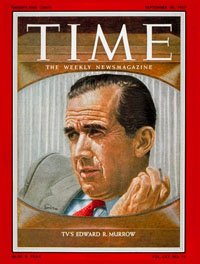
Murrow Quotes


For Tom Trowbridge


“Just once in a while let us exalt the importance of ideas and information.”
“We cannot make good news out of bad practice.”
“We're going to go with this story. Because the terror is right here in this room.”
“Difficulty is the excuse history never accepts.”
“Our major obligation is not to mistake slogans for solutions.”
“We cannot defend freedom abroad by deserting it at home.”
“No one can terrorize a whole nation, unless we are all his accomplices.”
“We are in the same tent as the clowns and the freaks-that's show business.”
“Anyone who isn't confused really doesn't understand the situation.”
“If we were to do the Second Coming of Christ in color for a full hour, there would be a considerable number of stations which would decline to carry it on the grounds that a Western or a quiz show would be more profitable.”
"We must not confuse dissent with disloyalty.”


Tom,
I hold you in the highest regard.

Rogi A. Riverstone

Thursday, September 01, 2005

Katrina

You are reading http://rriverstoneradio.blogspot.com/

Is my credit card information secure?My donation was denied. Why?Can I cancel a donation?View All FAQsAmerican Red Cross Emergency Vehicles respond to disasters nationwide.Did you know... The American Red Cross provides assistance to people in need... free of charge... every single day!Donate by Phone Donate by Mail Donate Spare Change Donate In-Kind Products Donate Airline Miles Donate Stock Latest NewsPrivacy Policy Dear Rogi,Thank you for your generous gift to the American Red Cross 2005 Hurricane Relief Fund. This fund makes it possible for the Red Cross to help nationwide Hurricane disaster victims of 2005 with critical needs such as shelter, food, clothing, counseling and other assistance. It's because of the 2005 Hurricane Relief Fund that our response can be immediate regardless of its location or the community’s ability to financially support our efforts. Your generous support means the most to the families who rely on Red Cross to help them through some of the most difficult times of their lives. Please continue to visit us at http://www.redcross.org/ to see how we’re using your 2005 Hurricane Relief Fund donation to make a difference, and for the most current disaster updates and stories about the people being helped.Together, we can save a life.American Red Cross*************************************************To verify that your company participates in a matching gift program, please contact your human resource representative.Please print or save this message for your personal records.Donation InformationDonation Form:Hurricane 2005 Relief and other Related EventsThis organization's tax ID is:53-0196605This letter serves as the tax receipt for your gift. The American Red Cross is a tax-exempt, nonprofit organization as described in section 501(c) (3) of the IRS Code for 1984, as amended. Our tax identification number is 53-0196605. Adequate records will be maintained and made available to the IRS upon request. In accordance with IRS regulations, no goods or services were provided to the donor by the American Red Cross as part of this contribution.Your gift may be recognized in future Red Cross publications. If you prefer your gift to remain anonymous, or have questions about your gift’s designation, or would like to learn more about the services that the Red Cross is committed to providing, please call 1-800-797-8022.The American Red Cross is not a government agency and all Red Cross disaster assistance is free thanks to the generosity of people like you. The value of your donation is increased by the fact that the ratio of volunteer Red Cross workers to paid staff is almost 36 to one.Contributions to the American Red Cross, a tax-exempt organization under Section 501(c)(3) of the Internal Revenue Code, are deductible for computing income and estate taxes.© Copyright The American Red Cross. All Rights Reserved.

Thursday, April 07, 2005

auction

You are reading http://rriverstoneradio.blogspot.com/

One can find info on this "auction" at http://kunm.org

I was horrified and wrote this:

Seems Goodman has also agreed to "Preferred" seating, with reservations, to her lecture for KUNM volunteers. Well, a dinner conversation is different than a lecture. We don't get to interact; we just get to listen, closer than the rest of the thundering herd.

It's not ok to exclude the majority.

E-mail message

(Gather�ideas�from�KUNM�volunteers)
From: (Rogi�Riverstone)
Date: Tue, Apr 5, 2005, 4:26am
To: KUNMIDEAS-L
Subject: Re: [KUNMIDEAS-L] KUNM Benefit Online Auction with Amy Goodman

"The minimum bid for the KUNM auction is $125.00. If you make a generous contribution of $1,000 we will automatically reserve a seat at the table for you, with no other bid required."

These "twenty, lucky winners" aren't lucky, at all; they're privileged. Period.

Volunteers come to KUNM and toil tirelessly to keep COMMUNITY radio on the air. Those contributions are, in my opinion, taken for granted by staff, whose salaries come, in large part, from the hard work of volunteers.

Not ONE seat at this table is reserved for volunteers. MANY of us are low income, and could NEVER afford a seat at that table.

"Whatsoever you do to the least of these, that you do also unto me." -- Jesus

Thank you, one, more time, for the respect and dignity we volunteers deserve as the backbone of the station: a station which, more and more, reflects the privileged and not the COMMUNITY from which it comes.

That Amy Goodman agreed to this speaks volumes as well.

This is community radio; it is not a country club. Nor is it a college fraternity.

Thank you,
Rogi Riverstone
http://rriverstone.com

Exclusive

You are reading http://rriverstoneradio.blogspot.com/

This is an email to the KUNM ideas list, re: a "benefit" for the station.


E-mail message

(Gather�ideas�from�KUNM�volunteers)
From: (Rogi�Riverstone)
Date: Thu, Apr 7, 2005, 8:45am
To: KUNMIDEAS-L
Subject: Re: [KUNMIDEAS-L] KUNM Benefit Online Auction with Amy Goodman

Words like "preferred" (as in seating) and "exclusive" (as in undisclosed location of events for the wealthy, to keep us riff raff out) are, in my opinion, the antithesis of community. They divide. They don't unite.

Statistically, I've heard and read, it is the people more likely to use the services of nonprofits and charities who donate the most to them. Therefore, lower working class people donate the most.

My experience in community fund raising teaches me that it's a lot easier to get a thousand people to donate twenty dollars each than to get twenty to donate a thousand each.

And this is for a radio station; we have the ability to promote events very handily to most of the state.

We have great talent in Albuquerque: artists, environmentalists, musicians, chefs, lecturers, poets..... Many of them would donate their time and knowledge to fundraisers. Nature walks on water conservation and native plants. Poetry slams. Crafts festivals. Dinner-for-two raffles. Open mic picnics. KUNM Aid concerts. Bed and breakfast weekends......

It would be a fabulous way for listeners to meet each other, to build a sense of community. We could get to know each other. I saw many people who were very excited to hear from each other at the media conference at TVI. A lot of us didn't know others felt as we did. It was very healing.

I worry about the influence the wealthy can have over programming decisions at KUNM. Who lives in Santa Fe? Shirley McLaine? Who, in "Out On A Limb," (the LAST time I'll ever read a book by her), said she no longer felt a sense of duty to social justice, because, in her warped interpretation of "karma," has decided people CHOOSE to live in suffering, to work out some hidden, cosmic agenda!

Or maybe it'll be Ali McGraw, who, on a KNME special about celebrities and trees, whined that she must stoop under the branches of a pinon that grows in her yard, because she refuses to allow her (working class) gardener to trim it. No mention was made of how much fun it must be for the gardner to conk his/her head on the branch and get stabbed in the eye, trying to rake under the tree.

Maybe Santa Fe only wants to hear new age happy talk? Maybe they only want white, talking heads? Maybe they want puff about their investments?

Scott Company underwrites programming on PBS. They produce Round Up. Monsanto pushes GMOs that are Round Up resistant in the 3rd world. Their subsidiary, Abbot Pharmacies, produces AIDS drugs. The deal is: if 3d world govts. refuse to allow GMO crops, Abbot won't provide low-cost AIDS meds. Scary.

And ADM underwrites PBS news: supermarket to the world. Scary.

The agenda of the wealthy worries me. Remember in Paper Moon. Dad says he won't do something because, "I have scruples. You know what scruples are?" Daughter replies, "No, I don't know what scruples are. But if you got 'em, you sure as hell stole 'em from someone else!" Privilege comes, almost always, at the expense of others.

So, promoting an event in which most people can't participate and aren't even allowed to know its venue sends a message to KUNM listeners which I find extremely problematic.

Amy Goodman, who sneered at the Bush campaign's multi-thousand-dollar a plate dinners, in which GW smiled to the wealthy and said, "YOU are my constituents," scoffed at Bush rallies, in which the Department of Homeland inSecurity BARRED any but the faithful from attending, is participating in what, to me, is just as exclusive and just as dismissive of the struggles of low income people. Having all the verses to "Brother, Can You Spare A Dime" memorized is not radicalism.

Exploiting the urgent needs of the poor to self-promote (which is what it's starting to look to me like she has done to sell books) is evil, whether republicans do it or communists do it.

I'm hurt. I'm offended. If I can't trust community radio to represent my needs, whom shall I trust? Fundamentalists? Fascists? Corporations?

Thank you,
Rogi Riverstone
http://rriverstone.com

Friday, February 18, 2005

ClearChannel: Liberal?

You are reading http://rriverstoneradio.blogspot.com/

Clear Channel adopts liberal programming on growing number of stations
Date: Friday, February 18 @ 10:11:00 EST
Topic: Media
From The Associated Press

DETROIT -- The day before President Bush's inauguration, listeners tuning in to the Detroit sports station WXDX-AM were suddenly greeted by the sound of braying donkeys. By the time Bush was taking the oath of office, the radio station had new call letters and a full schedule of liberal talk shows.
WXDX-AM -- now known as WDTW-AM -- is one of 22 stations owned by Clear Channel Communications Inc. that have switched to a liberal talk format in the last year. This month, KTLK-AM in Los Angeles became the latest Clear Channel station to adopt the format.

Those who track broadcasting trends say there's money to be made in liberal talk radio. Todd Webster, a consultant for Washington-based liberal talk show producer Democracy Radio, said Clear Channel is expected to introduce the left-leaning format on 20 more stations by the end of the year.

"There is a tremendous appetite out there for progressive talk," he said.

Webster said that even as recently a year ago, no one thought Texas-based Clear Channel, a media conglomerate that owns 1,200 stations -- including Twin Falls radio stations KEZJ-FM, KLIX-AM and KLIX-FM -- would ever become partners with upstart liberal talkers.
"There has been a tectonic shift in the industry from all of the big brains and the head honchos saying, 'Nobody wants to listen to a bunch of whiny liberals on the radio,"' Webster said.

The partnership might seem surprising because of Texas-based Clear Channel's conservative reputation. Clear Channel CEO Lowry Mays and his wife gave $65,000 to the Republican National Committee in the last election cycle, and two-thirds of the company's federal donations went to Republicans, according to the Center for Responsive Politics.

And last summer, a Berkeley, Calif.-based group sued Clear Channel, which also owns an outdoor advertising business, after it refused to run an anti-war billboard in Times Square during the Republican National Convention.

The company also isn't seen as socially progressive. In December, Clear Channel stations in Tampa, Jacksonville, St.
Louis and Detroit awarded breast enhancement surgeries to 13 women as part of the "Breast Christmas Ever" contest; at the time, the company said it had no oversight of the contests and didn't sponsor them. Clear Channel also pulled talk show host Howard Stern off the air because of concerns over mounting indecency fines.
The company says politics aren't involved in its decision to put liberal talk shows on the air.

"I'm trying to identify needs in our various communities, whether it's German industrial music or punk rock or progressive talk," said Gabe Hobbs, vice president of news and talk programming for Clear Channel. "That happens to be good business."

Hobbs said Clear Channel began programming offerings from Air America Radio, which produces comedian Al Franken's three-hour talk show, and Democracy Radio, which produces a popular show by liberal talker Ed Schultz, because listeners were demanding an alternative to conservative talkers like Rush Limbaugh during the 2004 election.

"The election dramatically raised everyone's interest in hearing political talk," Hobbs said. "I think polarization is one of the facets of any talk radio format, regardless of orientation."

Hobbs said liberal radio is actually a return to the days before Limbaugh, when talk radio was dominated by left-leaning hosts like Alan Colmes, who is now seen on Fox News Channel's "Hannity and Colmes."

Local station managers have the final say over the switch in programming. At WDTW, General Manager Dave Pugh was eager to give Detroiters a format they couldn't find anywhere else.

"We are a blue state and a blue region and it just made sense," Pugh said.

From Associated Press:
http://www.magicvalley.com/news/business/index.asp?StoryID=7501

This article comes from The Smirking Chimp
http://www.SmirkingChimp.com

The URL for this story is:
http://www.SmirkingChimp.com/article.php?sid=19969

Tuesday, February 01, 2005

Queer & Homeless

You are reading http://rriverstoneradio.blogspot.com/

PRESS RELEASE The 8th Annual Homelessness Marathon
FOR IMMEDIATE RELEASE
MEDIA CONTACT:
Rogi Riverstone
Albuquerque: 505-842-8175
Toll Free: 1-877-718-0691
(rriverstone@yahoo.com)

8th ANNUAL HOMELESSNESS MARATHON Broadcasting in Albuquerque

Local producers will carry a live, hour discussion, to be aired at 10pm local time, on the impact of homelessness on Gay, Lesbian, Transexual, Transgendered, Pansexual and Bisexual people in Albuquerque. Stay tuned to KUNMfm 89.9 and http://kunm.org for further details.

The 8th Annual Homelessness Marathon is a nationally-produced show. Participating Pacifica, NPR and independent, community and public radio stations will both broadcast and air it. The Marathon will be broadcast from 9pm, EST on Monday, February 14th to 11am, EST on Tuesday, February 14, 2005. The broadcast will be carried on KUNMfm 89.9.

The Homelessness Marathon has been called, "the most significant media event focusing on homelessness and poverty" by Donald Whitehead, director of the National Coalition for the Homeless. And it is unlike any other broadcast in the world.
The Marathon is almost entirely live, covers taboo territory and features the voices of people who are rarely heard on the air. Perhaps for this reason it has grown rapidly. The first Marathon, in 1998, was on one tiny station in central New York. The 7th Marathon, in 2004, was on 80 stations coast-to-coast, with another 30 stations across Canada carrying a parallel Canadian Homelessness Marathon.

As always, the 8th Marathon's broadcast booth will be set up outside, to dramatize the plight of people with nowhere to go in the cold, and calls will be taken from around the country. But there will be no on-air solicitations. The Marathon is a consciousness raising, not a fundraising broadcast.
The 8th Marathon will be distributed via the NPR and Pacifica satellites and will be streamed on the web. More information, including broadcast schedules and audio clips from past broadcasts may be found at the Marathon's web site: http://kunm.org and http://www.homelessnessmarathon.org.

Tuesday, January 18, 2005

Women's International News Gathering

You are reading http://rriverstoneradio.blogspot.com/

Dear WINGS contributing producers:

I am opening a new email for WINGS producers to write to me. It is wingsproducers@yahoo.com. Using this email will keep your messages from bouncing when the wings@wings.org email box is full, and will make it easier for me to keep track of our correspondence.

WINGS is also going to try something different this year, which is a discussion list for WINGS producers.
Soon you will get an invitation from yahoo asking you to join the wingsproducers@yahoogroups.com listserve. � Please respond to it if you are willing to receive email from this list.

The 40 producers I am inviting work in 16 countries. Almost all of you have had a piece appear in WINGS in the past two years. A few have pieces that are pending or have proposed ideas that I feel confident you can complete.

The reason I am creating this listserve, is that I feel it is not good for just me to be the only person at WINGS who is in touch with all of you. Using this list, you can help set priorities, share ideas and leads, and pressure me to do my job of coordinating better. My hope is that we will develop a sense of community around being active in WINGS.

Only members will be able to send messages to this list, or receive messages from it. If you feel there are too many messages, I will change it to be "moderated," so that messages for the whole list only come through me.

If you have a yahoo.com email account, you will also be able to see things posted to the web for this group. There should be enough room for pictures and audio. Right now, we have 250 megs of space, which is equivalent to about 10 half-hours of mp3 sound. � It is possible to purchase more space.

If you do not have a yahoo.com email account, you can receive emails but not see what is posted on the web. I believe you can register to get a free yahoo email account, at www.yahoo.com. Let me know if you change your email.

You can write to just me at wingsproducers@yahoo.com. The email for the whole list will be wingsproducers@yahoogroups.com.

Hoping to see you together online.

Frieda
Frieda Werden, Producer,
WINGS: Women's International News Gathering Service,
Box 95090, Kingsgate
Vancouver BC V5T 4T8
Canada

Tuesday, January 11, 2005

where's da broadcast?

You are reading http://rriverstoneradio.blogspot.com/

KNME, our local PBS station, shares our transmission tower. Well, at three days' notice, they've informed us they'll be knocking us off air from midnight to 5am all week.

Our volunteer coordinator is madly riding her bike all over town, locating late night broadcasters who don't have phone and email, informing them they don't need to come in.

At 6:38 this morning, our poor station STILL didn't have a signal!

Our Chief Engineer posted the following in our email list:

Dear Boss,

I like 1.6 million other New Mexicans will be late to work today due to the failure of radio station KUNM to wake me up. �Please note that KUNM was off the air until
6:33 AM and therefore I am running an hour and a half late.

Please don't blame KUNM as they have no control over the situation and are at the mercy of KNME-TV who held the FM station at bay until after 6:30.

Should you have any questions concerning my lateness, please contact Ted Garcia or James Gale, KNME-TV, (505) 277-2121.

I'd like to avoid being tardy again, but you should expect this from me as KUNM will be off the air again over the next three nights.

Sincerely,

Joe Employee

Monday, January 10, 2005

Homelessness Marathon

You are reading http://rriverstoneradio.blogspot.com/


Homeless?

Gay, Lesbian, Transgender, Transexual, Bisexual, Pansexual?

We want to hear from you!

Join us for a live discussion.

February 14, 2005


(hour still to be determined)


KUNMfm Albuquerque (http://kunm.org) will host a one-hour broadcast during the Homelessness Marathon. Our local focus will be about the issues facing the Queer community who are homeless.

Participants have the options of remaining anonymous. We can even digitally alter your voice, so you can't be recognized.

We want to hear your experiences, not cause further victimization. Your voice matters. Your experience is important. This is an opportunity to tell a national audience what life is like as a homeless person who is maginalized as a result of your sexuality, gender and orientation.


(505) 842-8175 Albuquerque or 1-877-718-0691

rriverstone@yahoo.com

The URL for this flier is

http://rriverstone.com/homelessmarathon/flier.html

Please feel free to print, distribute and post this flier anywhere!


Friday, October 22, 2004

CURSE on radio

You are reading http://rriverstoneradio.blogspot.com/

Food for thought:

Several speakers described the steady process of de-democratization that has been going on there, the transference of decision-making from volunteers to one autocratic paid staff person, and the gag rules and dismissals placed on volunteers who voiced protest. A speaker from KUNM, New Mexico, described the successful listener fight at her station several years back, in a surprisingly similar situation. This kind of thing has been going on at stations all over the country, where those who want to attract ratings and appeal to a "safe," homogenized audience are using arbitrary power to take choice out of the hands of the community. In some of those situations, management has won, but in others, listeners have been successful in taking back their stations.

Both DJ Riz, who spoke at the forum, and the speaker from New Mexico, discussed the necessity not only to take back community radio but also to expand it to become more truly responsive to the community, including a diversity of cultural groups: Latinos, Asians, women, queers, and disenfranchised white males. Speakers were heavily applauded by the audience for such statements as "you are not the respectable Arbitron listeners," and "you don't want familiarity, you want to be offended and challenged by what you listen to." When management says that they want to tone down the station to make it more "respectable," they claim that there is no audience for what the "maverick" DJs are playing. The CURSE meeting showed that there is an audience for so-called "harsh and abrasive" music (and harsh and abrasive opinions), and it is us.

http://www.bloofga.org/il/il_v1/output/indie-list-9.html

Thursday, September 30, 2004

The marshalls and the microstation

You are reading http://rriverstoneradio.blogspot.com/

Posted on Thu, Sep. 30, 2004

Marshals shut down Santa Cruz radio station
CROWD BACKS TINY HOST TO LOCAL PROGRAMS
By David L. Beck
Mercury News

Guns drawn, agents of the U.S. Marshals Service served a warrant on a tiny Santa Cruz pirate radio station early Wednesday, rousting and frisking the pajama-clad residents of the co-op house from which the station had been broadcasting. No one was arrested.

``This is not a criminal action against people,�� said Supervising Deputy Cheryl Koel.

The target was Free Radio Santa Cruz, an FM micro-station boasting 35 to 40 watts of power and offering round-the-clock music, activism and other local programming, in addition to such national programming as Radio Pacifica's ``Democracy Now��-- all in defiance of federal licensing laws.

The blue-jacketed marshals, along with agents of the Federal Communications Commission, dismantled the station's equipment and carried it to a waiting pickup with a camper shell as a crowd of perhaps 60 people yelled ``Shame! Shame!�� and ``Go home!��

Residents, programmers, friends of alternative radio and enemies of corporate media were joined by two city council members, one council candidate and two congressional candidates. They milled around on the sidewalk and in the street, careful to avoid traffic.

Culinary consultant Joseph Schultz, founder of the legendary but now defunct India Joze, brought vegetable soup.

But despite Koel's assurances, residents of the house on Laurel Street did feel ``acted-against.��

``They got me out of bed,�� said Erin Calentine, 21. ``They were yelling, `Federal marshals! We have a warrant! Come down! We�re here for the radio,� �� she said.

After being frisked, the residents were kept outside for about half an hour while the marshals ``secured the location,�� said Calentine, quoting the marshals.

Mayor Scott Kennedy and Councilman Mark Primack condemned the raid, while candidate Tony Madrigal, a union organizer by profession, led a chant of ``S�, se puede�� -- the Cesar Chavez motto that means ``Yes, we can.�� The student co-op house is named for Chavez.

Kennedy said the city would be willing to lend assistance, perhaps by filing a friend-of-the-court brief. The fact that the station frequently airs criticism of city government ``makes it important�� that the city support it, Kennedy told the Santa Cruz Sentinel last year.

The warrant bore no names, listing as ``defendant�� ``any and all radio station equipment . . . used in connection with the transmissions.�� It gives the station operators 20 days to respond in court.

``I don�t want the reason we�re doing this to get lost in the hubbub about the raid,�� said George Cadmon, who hosts a show called ``Peace Talks.�� ``This is civil disobedience, anti-corporate action, First Amendment protest. We feel very strongly that local voices aren�t getting out there.��

Evelyn Hall hosts a program called ``Eye of the Storm,�� which she describes as ``spiritual activism.�� Her daughter and a friend, both 11, have their own show, too, called ``For Your Information.�� And so does her mother, Michelle Hall, 74.

``Could it be,�� she wondered, ``they are really kind of worried?�� Hall asked, reflecting the paranoia and anger circulating in the crowd.

The station's technical director, who as Uncle Dennis plays 1960s and '70s rock, psychedelic music and blues, said the FCC has had its eye on the station for years. Uncle Dennis said the station has moved several times during its nine-plus years of life on the fringes of broadcasting.

The FCC spokeswoman declined comment on the case except to say that it was an open investigation. A spokesman for the U.S. Attorney's office in San Francisco suggested a reporter consult the station's Web site, www.freakradio.org, where it charges that the FCC ``has proved itself to be controlled by monied interests.��

Cadmon estimated the value of the equipment seized at $5,000, including the antenna agents removed from the roof.

Contact David L. Beck at dbeck@mercurynews.com or at (831) 423-0960.


http://www.mercurynews.com/mld/mercurynews/news/9797653.htm?1c